Podcast
Lava Academy Podcast: Exploring Volcanoes, CO₂ & the Future of Our Planet
At Lava Show, we don’t just melt lava — we dig deeper into the science, stories, and people shaping our understanding of the planet. The Lava Academy Podcast is where the world’s only live lava show meets cutting-edge research and global geological expertise.
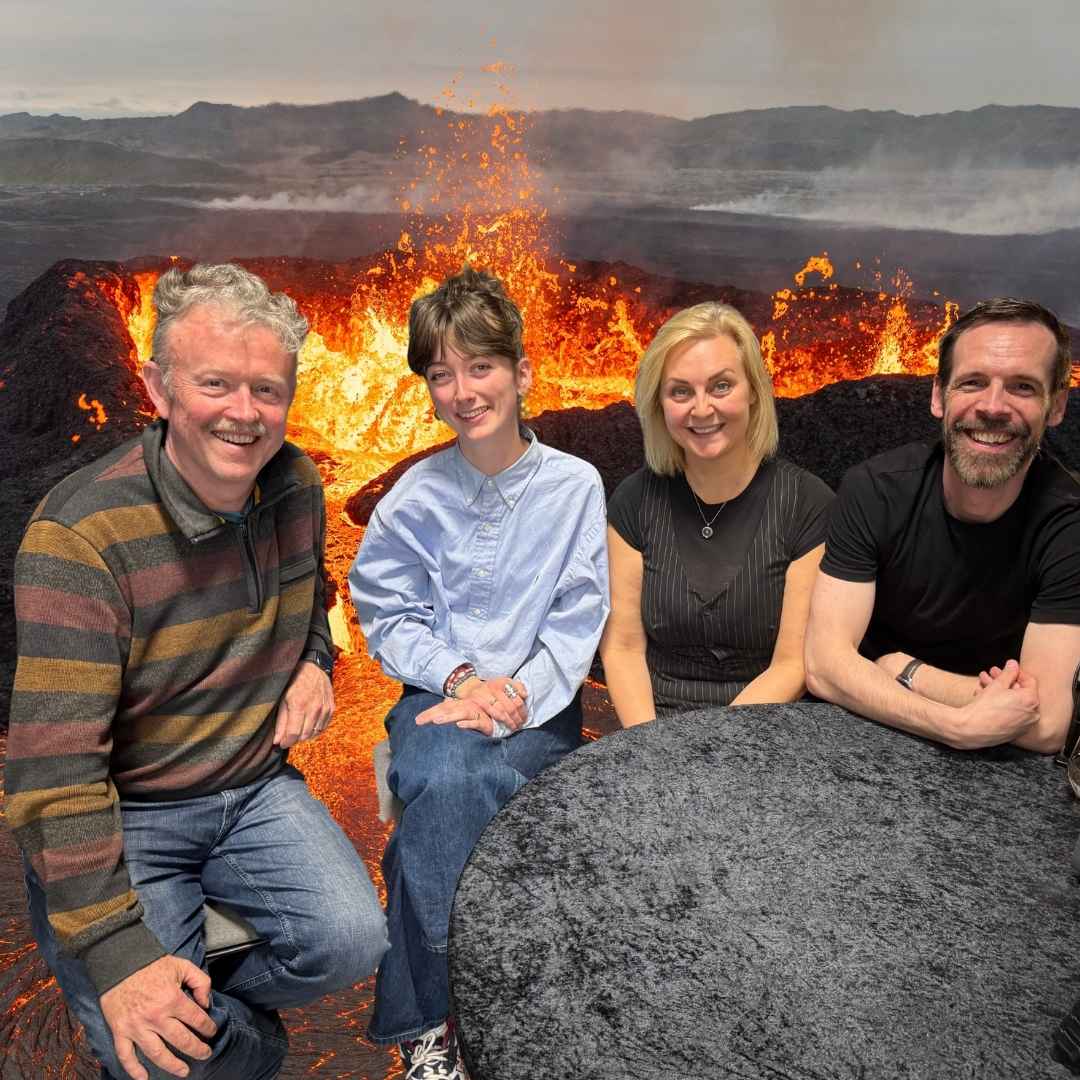
In our newest episode, hosts Iain MacKinnon, Lava Master at Lava Show, and Ragnhildur Ágústsdóttir, Founder of Lava Show (aka Lady Lava), sit down with two remarkable guests who are helping unravel one of the biggest questions of our time: What role do volcanoes play in Earth’s carbon cycle, and how can geology help us fight climate change?
This episode is a must-listen for anyone fascinated by volcanoes, climate science, or how Iceland’s unique geology could play a major role in shaping a greener future.
Meet the Guests
Professor Philip Ringrose
Professor in Energy Transition Geoscience, Norwegian University of Science and Technology (NTNU), Trondheim
Philip has spent decades at the intersection of geology, energy systems, and climate solutions. His research focuses on subsurface CO₂ storage — safely capturing carbon emissions and storing them deep underground. Though not a volcanologist, his love for basalt and Earth’s fiery origins was sparked in childhood when he first saw the vast Deccan basalt plateaus of India. Today, he investigates how volcanic rocks help us understand — and potentially fix — the planet’s carbon imbalance.
Chloé Delbé
PhD Researcher, specializing in CO₂ detection over volcanic regions
Chloé studies how natural CO₂ emissions rise through Earth’s crust, especially in tectonically active areas like Iceland and offshore Norway. Using satellite technology capable of detecting CO₂ from space, she is uncovering how volcanoes and faults release gases — essential knowledge for improving climate models and ensuring the safety of future CO₂ storage sites.
Video: Watch the podcast episode “Exploring Volcanoes, CO₂ & the Future of Our Planet”
Volcanoes & CO₂: What’s Really Going On?
A recurring misconception that Iain and Ragga hear both online and at the Lava Show is that volcanic eruptions release so much CO₂ that they rival human emissions.
Philip’s answer?
Not even close.
Volcanoes worldwide emit around 300 million tons of CO₂ per year, a huge-sounding number — until you compare it with humanity’s 40 billion tons. That means volcanoes contribute less than 1% of annual CO₂ emissions.
This surprising fact reframes volcanic activity: awe-inspiring, powerful, and Earth-shaping — but not the driver of today’s rapid climate change. If anything, major eruptions tend to cool the planet temporarily by pushing ash and sulfur into the upper atmosphere.
Can Lava Help Save the Planet?
One of the most fascinating threads in this episode is how Iceland’s basalt — the same type of rock that flows red-hot in our Lava Show — may be a key tool in fighting climate change.
Basalt is naturally reactive. When CO₂ dissolved in water is injected into it, the rock turns the CO₂ into stone in just a couple of years. Iceland’s groundbreaking CarbFix project has demonstrated this successfully, inspiring similar efforts worldwide. Philip explains that:
Basalts “want” to absorb CO₂ thanks to their chemistry.
This process mimics what the planet has done naturally for millions of years.
CO₂ storage is already safe, tested, and happening today — we simply need to scale it up.
But public perception can be a barrier. Some countries still associate underground CO₂ injection with risky industrial practices like fracking, even though the two processes are completely different. Education, communication, and science — exactly the kind of work the Lava Academy Podcast is here for — are essential moving forward.
Measuring a Volcano from Space
Chloé’s research brings a space-age twist: she uses satellites to detect volcanic CO₂ from orbit, down to 1 part per million.
Instead of collecting gas samples by hand, satellites measure tiny changes in sunlight reflected off atmospheric molecules. It’s complex, cutting-edge, and incredibly useful — both for climate monitoring and for mapping where volcanic gas plumes will travel during eruptions.
This kind of data is especially important for Iceland, “the weirdo of geology,” as Chloé affectionately describes it — a place where tectonic plates meet, magma rises, faults shift, and CO₂ emissions naturally vary from volcano to volcano.
Experience Real Molten Lava
Volcanic eruptions have played a major role in shaping Earth’s climate throughout history, making the connection between volcanoes, CO₂ and our planet’s future a fascinating topic. After listening to this episode of the Lava Academy Podcast, see the source of that volcanic power for yourself at Lava Show. Watch real molten lava flow just metres away in a safe and controlled environment and experience the incredible forces that continue to shape Iceland—and our world.
Plan your visit:
Experience Lava Show Reykjavík – Watch real molten lava flow in Iceland’s capital.
Experience Lava Show Vík – Experience the world’s only live lava show on Iceland’s South Coast.
Why Listen to this Episode of the Lava Academy Podcast?
This conversation is both scientifically rich and refreshingly accessible. Whether our hosts are talking about:
the chemistry inside basalt,the realities of climate policy, misconceptions about volcanic CO₂, or how satellites read the atmosphere like sheet music,
the episode keeps things grounded, fascinating, and full of those “I never knew that!” moments we love to share at Lava Show.
The episode also shines a light on something deeply important to us:
Understanding volcanoes isn’t just exciting — it helps us better understand our planet, our past, and the choices we must make for our future.
Links