Volcanoes
Types of Volcanic Eruptions: Effusive vs Explosive Explained
Learn the difference between effusive and explosive eruptions, and how magma type shapes volcanic behavior
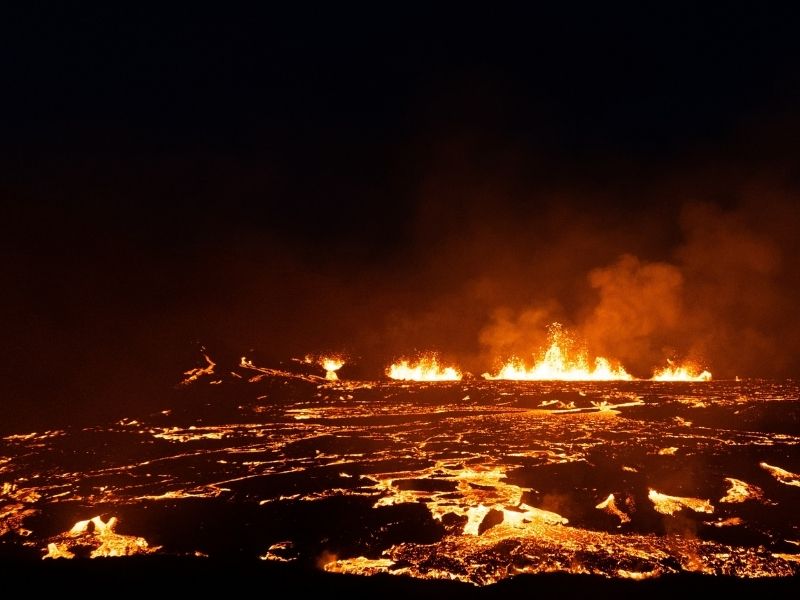
In the spring of 2021, in a valley in southwest Iceland, the earth fractured open and a curtain of lava rippled out from the ground. Within 24 hours, the eruption area had condensed into a small cone, and rivers of runny, fast-moving lava fed into hardening lava tongues.
People immediately hiked to the scene and the weekend that followed was one of wonder and joy. Folks gathered around the slowly creeping lava tongues to feel the heat and hear the volcanic glass crackle. Hikers sat on nearby hills, roasted hot dogs, and posed for selfies. This was the volcano at Fagradalsfjall, and it was safe to visit thanks to it being a certain type of calm eruption style.
In the autumn of the year 79, on the shores of the Gulf of Naples in what would later become Italy, the earth detonated in a towering cloud of ash and flame, and flows of hot gases and molten rock shot into the surrounding valleys. Tsunamis pummeled nearby coasts. Within 24 hours, entire cities had been buried by over 20 meters (65 feet) of pulverized, boiling pumice and lava fragments.
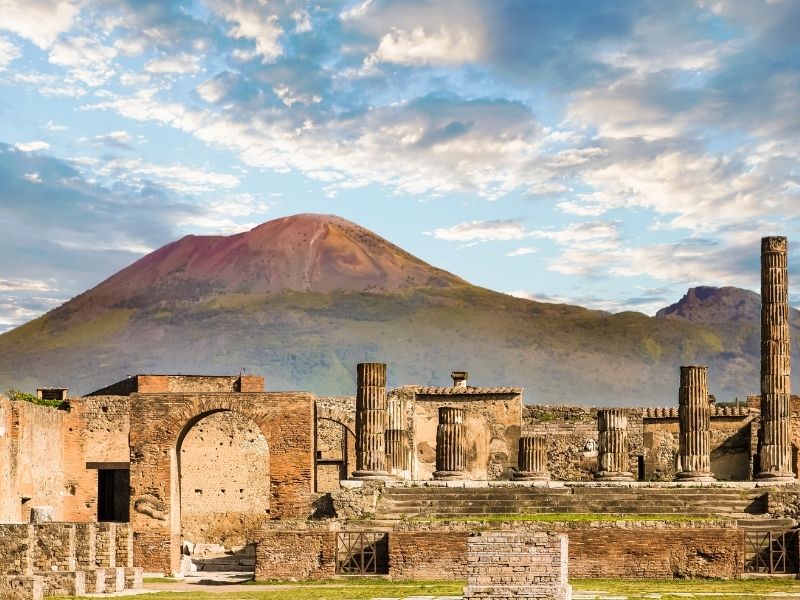
Mount Vesuvius looms over the ruins of Pompeii, a stark reminder of the devastating power of explosive volcanic eruptions.
this eruption, however, people were gripped with fear, racing for survival. Thousands perished as a result of the fast-moving, super-heated gas and rock that engulfed the region. This was the eruption of Vesuvius, which has become one of the most famous in western civilization. And unlike Fagradalsfjall, this volcanic eruption was wholly unsafe as it represents an opposite, dramatic eruption style.
But what are these two main volcano eruption types?
Whether you imagine a chaotic, debilitating Krakatoa or the calmer, hypnotic Kilauea when you hear the word “volcano,” both display end-member possibilities when it comes to volcanic eruptions. While almost every volcano on earth has its own unique eruption style, and those styles can change as a volcano evolves, let’s look at the two end-member cases of volcano eruption types:
Effusive eruptions
these “calmer” eruptions happen when lava flows out of a volcano smoothly and steadily, rather than exploding. The magma is usually low viscosity (i.e. runny, more fluid-like), which allows gases to escape easily from the magma instead of building up pressure.
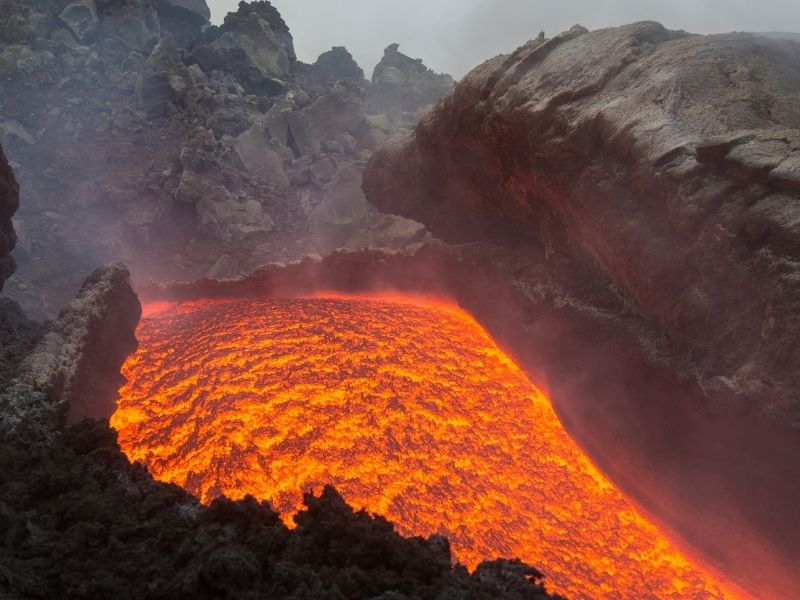
A classic effusive eruption at Mount Etna, where low-viscosity lava flows smoothly across the landscape rather than exploding.
This results in slow-moving rivers of lava that can travel across the landscape, like those seen at Kīlauea (Hawaii) and Sundhnúkur (Iceland). While they can still cause damage, they are generally less sudden and more predictable than explosive eruptions. They can also release large quantities of gases into the atmosphere.
Explosive eruptions
These “flashier” eruptions occur when viscous (i.e. thick, sticky) magma traps gas beneath the surface, allowing pressure to build until it is released violently. When the eruption happens, it can blast ash, rock, and gas high into the atmosphere in a matter of seconds. These eruptions are much more dangerous and unpredictable, like the famous eruptions of Mount St. Helens (U.S.A.) and Krakatoa (Indonesia). They can reshape entire landscapes and impact areas and climates far beyond the volcano itself.
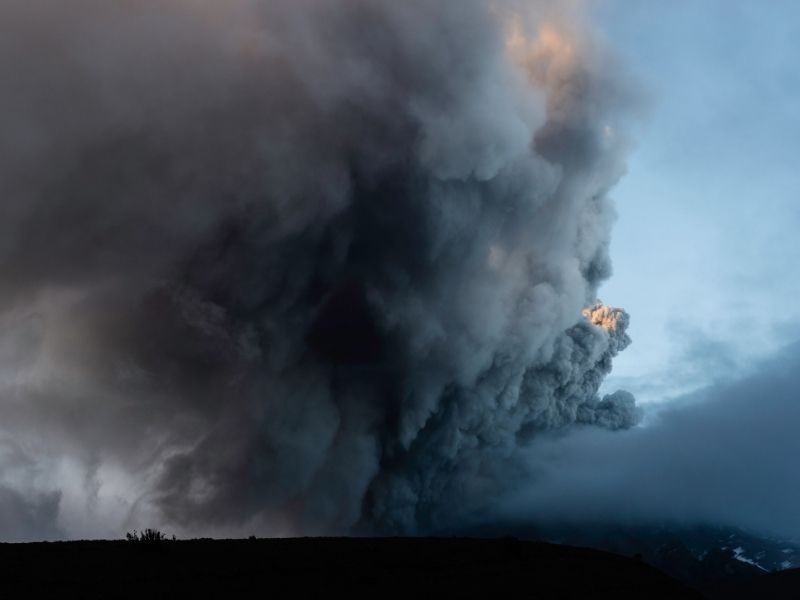
Ash and steam erupt from Cotopaxi in Ecuador during the 2015–2016 eruption, showcasing the dramatic power of explosive volcanic activity.
Of course, many volcanoes will exhibit both effusive and explosive eruptions over the course of their lifetimes, as magma chemistry, water saturation, or subsurface volcano plumbing evolves. Sometimes, like in the case of the Eldgjá eruption in Iceland in 939, both can happen simultaneously.
The Role of Gas: the key factor in effusive versus explosive eruptions
At the heart of every eruption is gas trapped within magma. Magma deep underground contains dissolved gases, much like bubbles trapped in a sealed drink. If the magma is thin and runny, those gases can escape easily as it rises, releasing pressure little by little and allowing lava to flow out gently. But if the magma is thick and sticky, the gas gets trapped, building pressure over time. Eventually, that pressure becomes too great, and it is released all at once in a powerful, explosive eruption. In simple terms, the ease (or difficulty) with which gas can escape is what often determines whether a volcano flows or explodes.
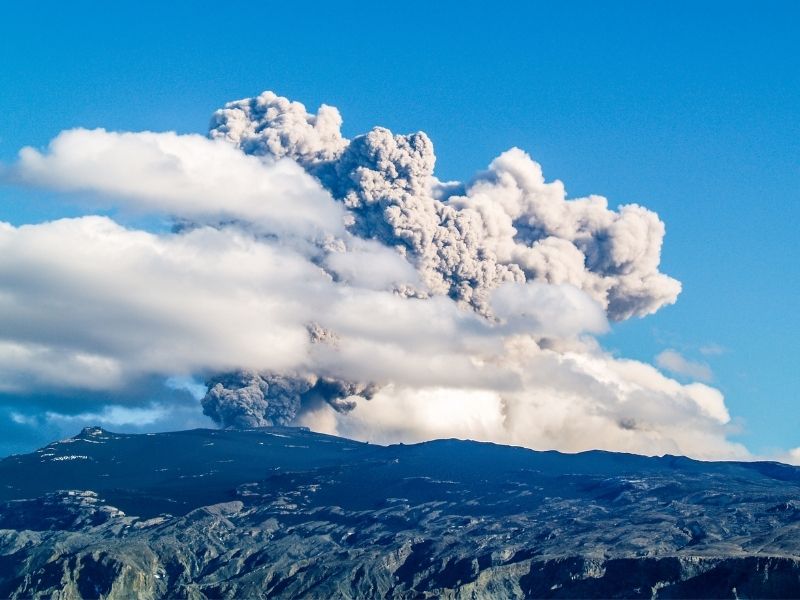
Eyjafjallajökull erupts explosively in Iceland, sending an ash plume into the atmosphere—an example of how gas-rich magma can create powerful, far-reaching eruptions.
A helpful way to picture this is through fun, everyday dining experiences. An explosive eruption is like opening a shaken bottle of champagne; the pressure has nowhere to go until the seal is broken, and then it bursts out violently, spraying liquid everywhere. An effusive eruption, on the other hand, is more like pouring honey from a jar. There is no trapped pressure, just a steady, controlled flow that spreads outward. These simple comparisons capture the same underlying idea: when gas escapes easily, eruptions are calm; when it is trapped, they become explosive.
(Please note, in this yummy analogy, the champagne is low viscosity (thin liquid) and the honey is high viscosity (thick fluid), which is the opposite of the characteristic of magmas in these eruptions; i.e. effusive eruptions have thin magmas and lavas, explosive eruptions have thicker magmas and lavas.)
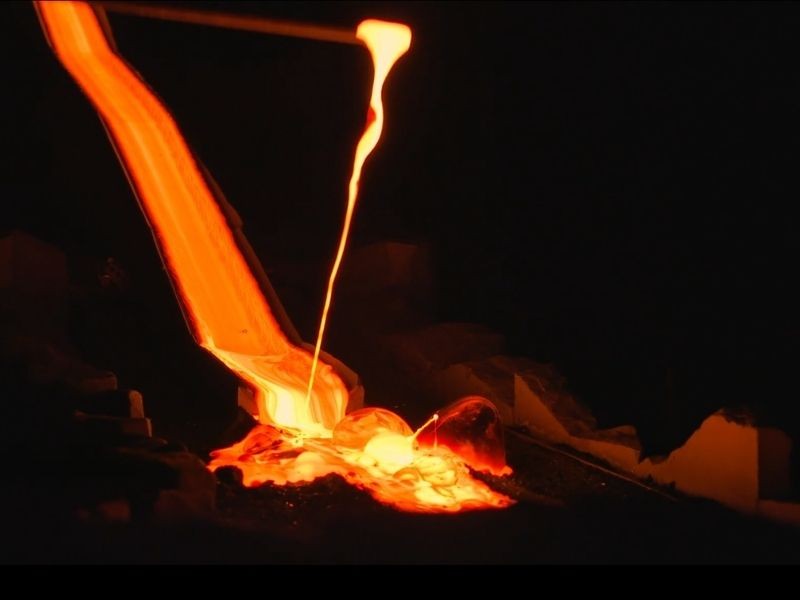
Real molten lava pours at Lava Show, offering a rare, up-close look at flowing lava in a safe, controlled environment.
Frequently Asked Questions About Volcanic Eruptions
Experience Real Molten Lava
From gentle lava flows to powerful explosive eruptions, Iceland's volcanoes can erupt in many different ways. At Lava Show, you can witness one of the most captivating parts of volcanic activity—real molten lava flowing just metres away in a safe and controlled environment. Feel the intense heat, hear the lava crackle as it cools and gain a deeper appreciation of the incredible natural forces that continue to shape Iceland.
Plan your visit:
Experience Lava Show Reykjavík – Watch real molten lava flow in Iceland's capital.
Experience Lava Show Vík – See the world's only live lava show on Iceland's South Coast.
The Lava Academy Podcast
Discover the Lava Academy Podcast and listen to in-depth conversations foscusing on the wonderful world of geology, volcanos and of course lava!
This article is written by geologist Jessica Poteet. Listen to the interview with her on the Lava Academy Podcast.