Guide to Lava Show
Introduction
Die Firma wurde im Jahr 2018 von einem isländischen Paar gegründet, Júlíus und Ragga. Inspiriert wurden sie durch den Ausbruch von Eyjafjallajökull und Fimmvörðuháls im Jahr 2010. Dieser Ausbruch wurde weltweit aus zwei Hauptgründen bekannt: Die enorme Aschewolke des Vulkans legte den gesamten Flugverkehr in Europa lahm und niemand konnte den Namen des Vulkans aussprechen. Am Ende erhielt der Vulkan den Spitznamen E-15. „E“ für den ersten Buchstaben und „15“ für die 15 folgenden Buchstaben. E-15 war der bekanntere Ausbruch, während den kleineren Ausbruch drei Wochen zuvor in Fimmvörðuháls die Isländer als „Touristen-Ausbruch“ bezeichneten. Júlíus und Ragga konnten ihn aus einer relativ kurzen Distanz miterleben, ebenso wie viele andere. Bei Fimmvörðuháls sahen sie mit eigenen Augen den größten jemals aufgezeichneten Lavafall, ganze 200 Meter hoch.
Beindruckt von dem, was sie dort gesehen hatten, wollten Júlíus und Ragga, dass jeder einmal solch eine unglaubliche Erfahrung machen kann, aber es gibt dabei einige Herausforderungen. Vulkane sind äußerst unberechenbar, und es ist unmöglich, genau vorherzusagen, wann sie ausbrechen werden. Zudem sind Vulkane natürlich sehr gefährlich. Zu den üblichen Gefahren, die mit Vulkanen verbunden sind, gehören Lava, giftige Gase, Erdrutsche, Flutwellen, Waldbrände und Explosionen. Dies sind natürlich die Gründe, warum die meisten Menschen nie einen Vulkanausbruch live erleben können. Júlíus und Ragga haben die Lava Show ins Leben gerufen, damit absolut jeder einmal einen Lavastrom erleben kann, und zwar ohne all diese Gefahren und in einer sicheren und kontrollierten Umgebung.
Video
After the introduction, there is a video that explains the geology of Iceland, the history of settlement by the Vikings at the end of the 9th century, and a few catastrophic eruptions after the settlement of Iceland. The volcanoes in this video are very dramatic, but travelers in Iceland need not worry; all volcanoes in Iceland are constantly monitored, and we already know if there is a high probability of something happening, allowing us to prepare accordingly. The three most important things we monitor are toxic gases, ground deformation, and earthquakes. This data is fed into an evaluation system, enabling us to track what each volcano is doing online at any time.
Lava flow
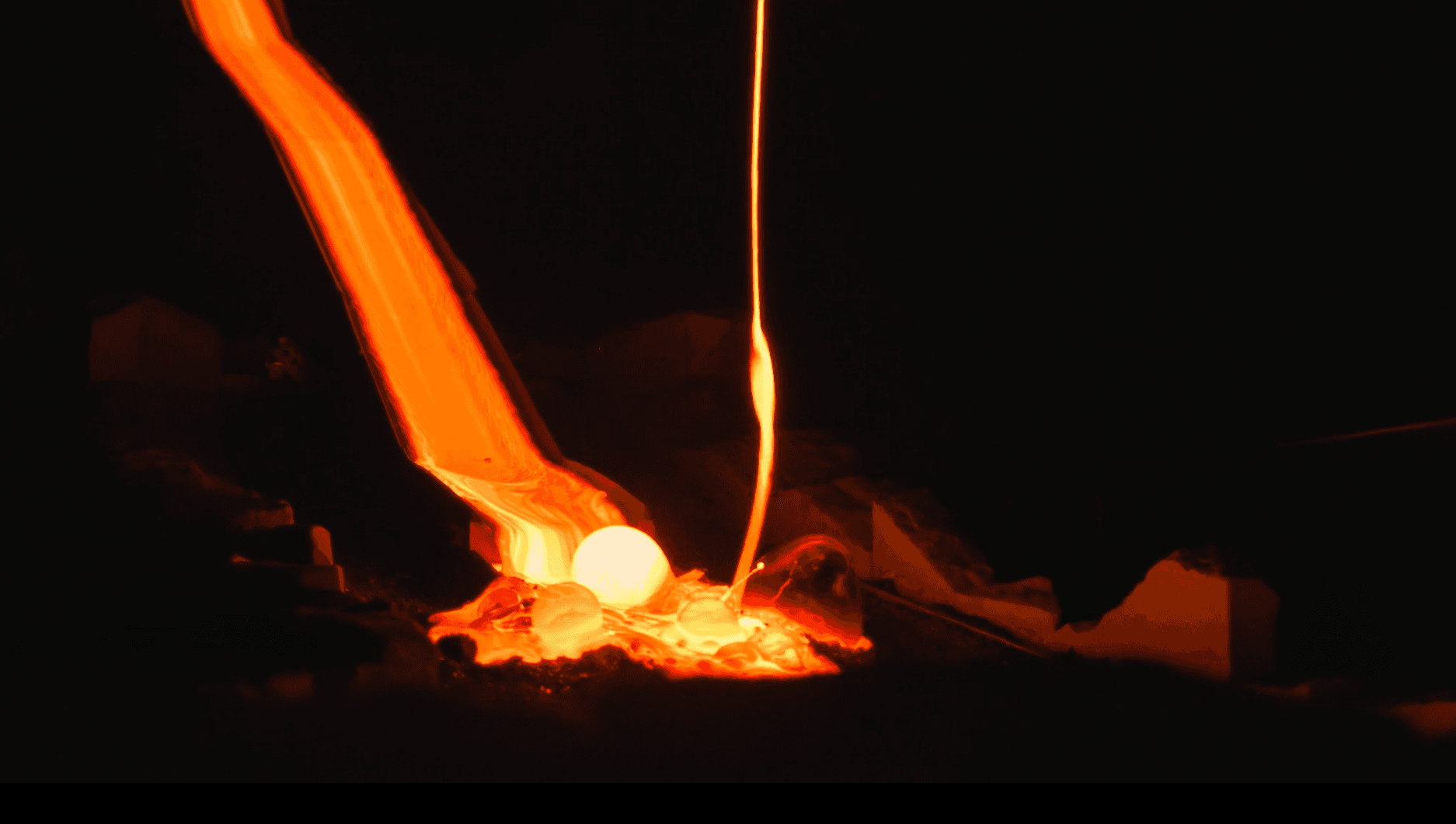
The lava flows out of a hole in the wall and moves down a channel. At this point, the lava enters the room at 1100°C. At the end of the channel, there is a block of ice. We placed it there because about half of the volcanoes in Iceland are covered by glaciers, so this interaction is quite common. What we hope to see here is a smaller representation of a "steam explosion"; the ice turns to steam and the steam gently bubbles out of the lava. There are two types of lava flows: A’a and Pahoehoe. An A’a flow has a lower temperature, is black, and very viscous. We will not see this today. We will witness a typical Pahoehoe flow, which is much hotter, more fluid, and bright orange. The black material at the bottom of the channel is basalt tephra and originates from the Katla eruption in 1928. It is our source material, what goes into the furnace to produce our lava.
Immediately after the video, when the lava enters the room, please put on the safety goggles located on your seat. Keep the goggles on until you leave the room at the end of the show. This is necessary to ensure everyone's safety. You may take photos and videos, but please without flash.
The Show
Pele-Haar sind dünne, fadenförmige Stränge aus Lava, die entstehen, wenn Lava von einer Kante fließt und vom Wind weggetragen wird. Da sie so dünn und zerbrechlich sind, sind diese Haare in der Natur nur schwer zu entdecken.
An ice block is placed on the lava. The ice melts, and even though most of it evaporates, some of it enters the lava and inflates it from within like a balloon.
Lava is an excellent insulating material, as it creates its own thermal insulation. The outer layer solidifies quickly, while the inner part remains hotter and stays liquid much longer. This process can lead to the formation of lava tubes. When lava flows occur in nature, the outer layer solidifies while the inner part remains liquid. Once the eruption stops, the still-liquid lava can drain from the solid crust, forming a lava tube. When lava cracks open, you can observe that the inner part remains red and glowing, while the outer crust appears black.
When lava hardens and cools very quickly, it turns into volcanic glass. There is not enough time to form crystals, which is different from regular glass. As the lava cools rapidly, the chemical components, predominantly silica or silicate (SiO2), combine. Silica refers to silicon combined with oxygen and water. While silica also forms regular glass, in this composition we get volcanic glass, whose black color is derived from magnesium and iron.
Das Quellenmaterial stammt aus dem Ausbruch von Katla im Jahre 1918. Der geologische Begriff dafür ist „Basalt-Tephra“, Basalt ist der Typ von Lava, die wir hier haben, Tephra bedeutet explodierte Stücke von Gestein. Diese Tephra entstand beim Ausbruch von Katla unter dem Gletscher Mýrdalsjökull. Der Mýrdalsjökull ist doppelt so groß wie Reykjavík und bis zu 700 Meter dick. Als der Vulkan Katla unter dem Eis ausbrach, verursachte das riesige Dampfexplosionen, die die Lava zu Tephra gesprengt haben. Darauf folgte dann eine Gletschersturzflut, bei der Schmelzwasser, Eisberge und Tephra aus dem Gletscher herausbrachen. Das Wasser strömte ins Meer und was auf dem Land zurückblieb, war eine schwarze Sandwüste und ein schwarzer Strand. In diesem Bereich, der durch die Lava von 1918 gebildet wird, sammeln wir Lava auf, stecken es in unseren Ofen, und boom! Brandneue Lava.