Description of the Lava Show
Introduction
The company was founded by an Icelandic couple, Julíus and Ragga, in 2018. They were inspired by the eruption of Eyjafjallajökull and Fimmvörðuháls in 2010. The Eyjafjallajökull eruption became famous worldwide for two reasons: On one hand, the enormous ash cloud from the volcano halted all air traffic in Europe, and furthermore, no one could pronounce the name of the volcano. In the end, the volcano had to receive the nickname E-15. "E" for the first letter, and 15 for the other fifteen letters that followed. Although this is the most famous eruption that took place in 2010, three weeks prior, there was another smaller one at Fimmvörðuháls. This smaller eruption was known as a "tourist eruption," so Julíus and Ragga were able to see it in person. On this visit to Fimmvörðuháls, they witnessed the largest lava fall ever recorded: 200 meters in height.
Julius and Ragga were amazed by what they were seeing and felt the need that everyone should have the opportunity to experience something as incredible as this. But the reality is that there are many challenges to experiencing something like this: volcanoes are unpredictable, it's impossible to know exactly when they will erupt, and of course, volcanoes are dangerous (lava, toxic gases, ground deformation, floods, wildfires, and explosions). These are the main reasons why most people do not get to see eruptions live, and in their attempt to eliminate these challenges, Julius and Ragga created Lava Show. This way, everyone can experience seeing a river of lava right in front of their eyes, without any danger.
Vídeo
The video explains part of Iceland's geology, the history of Viking settlements, and some catastrophic eruptions that have occurred in Iceland since its settlement. The volcanoes featured in the video can be very striking and dramatic, but they do not intend to scare you about Iceland's volcanoes.
In Iceland, volcanoes are monitored very closely, which allows knowing when something might happen and being prepared for it. The 3 main things that are monitored are: toxic gases, ground deformation, and earthquakes. This data is included in a volcano classification system, so you can check the status of all our volcanoes online at any time.
Lava
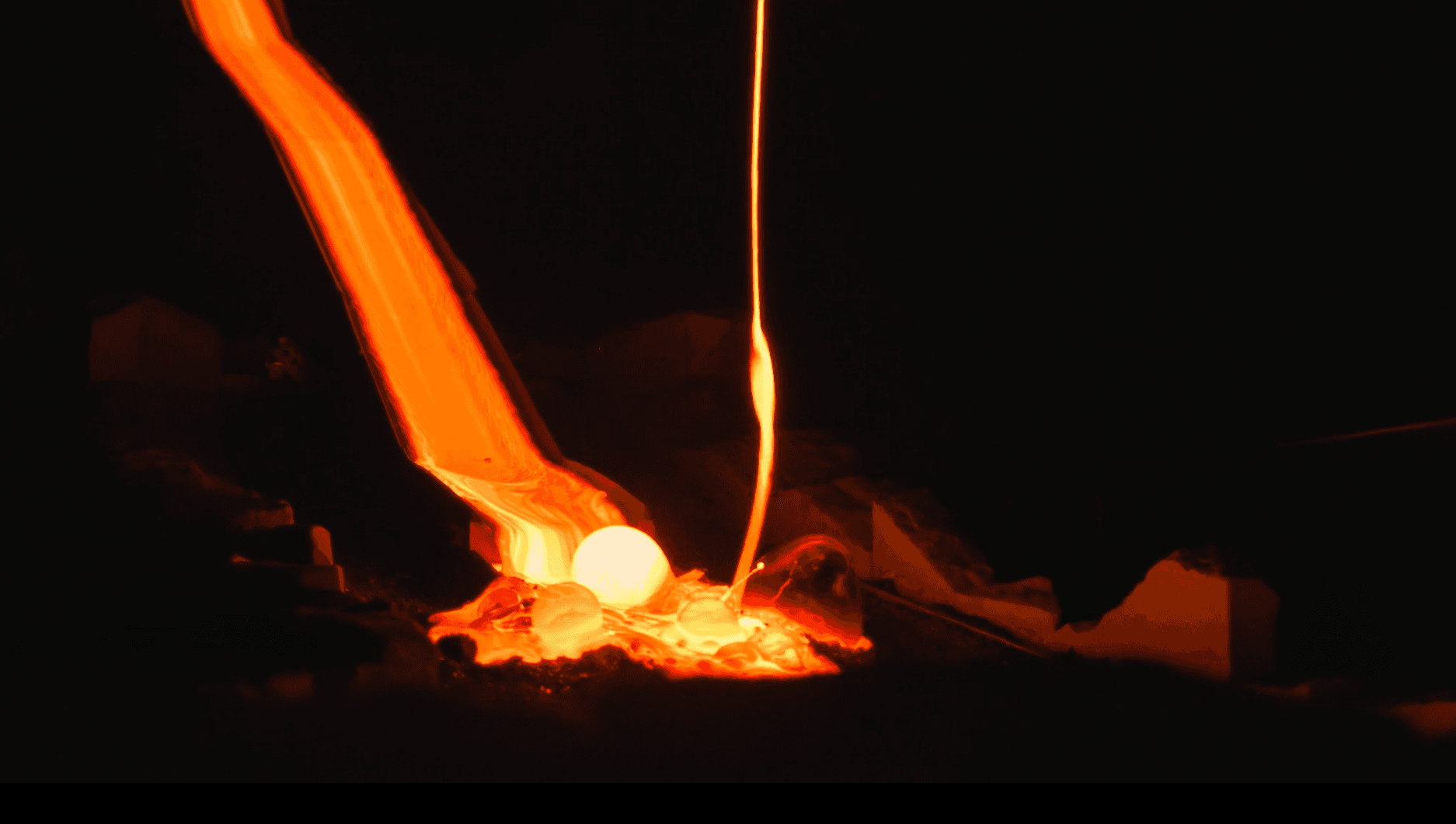
The lava will come out through the hole in the wall and flow down the slide. The lava enters the room at 1100ºC (2000ºF). At the base of the slide, a block of ice is buried. We put it here because approximately half of Iceland's volcanoes are covered by a glacier, so this lava-ice interaction is very common. What we hope you can see is a small representation of a 'steam explosion': the ice will turn into steam and the steam will gently bubble out of the lava. There are two types of lava flow: A'a and Pahoehoe. A'a lava is cooler, black, and very thick. We won’t see that today; instead, we'll see a typical Pahoehoe lava flow, which is much hotter, fluid, and bright orange. Inside the slide area, there is basaltic tephra (black sand) from the 1918 Katla eruption. This is also our source material, as it's what goes into the furnace to make our lava.
Once the video is over, you must put on the safety glasses you found on your seats. Please keep them on until the end of the show to ensure everyone's safety.
Photography and video are allowed, but please keep the flash off.
The show
The 'hairs of Pele' are small strands of lava, naturally formed by lava that falls from an edge and is carried by the wind. Due to how small and fragile they are, it is difficult to find them in nature.
The ice block placed on the lava. The lava behaves differently when in contact with ice, as the ice vapor causes the lava to swell. Notice that the top layer of lava has already solidified. When the top layer is solid, the vapor inflates the lava like a balloon.
Lava is a good heat insulator as it creates insulation for itself. Although the outer layer solidifies quickly, the interior can remain significantly hotter and stay liquid for much longer. This process can lead to the formation of lava tubes in nature. If a river of lava forms in nature, the outer layer of that river solidifies, causing the central part to remain liquid and flow. Eventually, when the volcano stops erupting, the flowing lava can drain out of its solid crust, leaving behind the insulating solid layer itself, and that is what is known as a lava tube.
When lava solidifies, it turns into volcanic glass. Volcanic glass forms when lava cools very, very quickly, so fast that there isn't time for crystals to form within it. It's different from regular glass. When lava cools rapidly, all the elements that make it up bind to the material it is composed of, which is mostly silica (SiO2). When everything binds to the silica, it all resembles silica. Silica is the main ingredient in regular glass, which is how we get volcanic glass. The black color is due to magnesium and iron.
When lava breaks, you can see how the inside of the lava remains red and bright, but the outer crust of it is black. This is how insulation works: the outer part cools first and becomes black, trapping the heat so that the central part stays hot for a longer time.
The source material comes from the eruption of Katla in 1918. The geological term for this is "basaltic tephra." Basaltic refers to the type of lava it is, and tephra are the fragments of rock that exploded. This tephra formed when Katla erupted under the Myrdalsjökull glacier. Myrdalsjökull is twice the size of Reykjavik and up to 700 meters thick. When Katla erupted under the ice, it caused huge steam explosions that blasted the lava into tephra. Then, a glacial flood occurred: all the meltwater, icebergs, and tephra broke free from the glacier. The water flowed into the ocean, and what remained on land was a black sand desert and a black sand beach. Today we go to the 1918 deposits, collect that black lava, put it in the kiln and boom! new lava.