ポッドキャスト
Lava Academy Podcast: Turning Lava into Design with Max Greiner
Can you make objects out of lava? A vase, a tray—or even a hot dog holder?
In this episode of the Lava Academy Podcast, we explore what happens when volcanic material meets design, craftsmanship and a willingness to experiment.
Hosts Iain MacKinnon and Ragnhildur Ágústsdóttir are joined by Lava Show’s very own Max Greiner, a designer and Lava Melter who operates the furnaces where we reheat real lava to around 1,100°C. Behind the scenes, Max has also been exploring how that molten rock can become something you can hold, use and keep.
His project brings together Iceland’s volcanic landscape, generations of family connections to glassmaking and one deceptively difficult challenge: how do you turn flowing lava into an object that survives cooling?
In This Episode
Discover how Max and the Lava Show team are exploring a new craft, one mould at a time.
Max shares:
How his family’s glassmaking history influenced his approach to design.
Why moving to Iceland changed how he thinks about materials.
How Lava Show became a testing ground for making objects from molten basalt.
Why carefully controlled cooling is essential to keeping those objects intact.
What vases, trays and a lava hot dog holder can teach us about the material.
How collaboration with local craftspeople could help the project develop further.
It is a conversation about creativity, persistence and finding unexpected possibilities in the rock beneath our feet.
Watch the video version of this episode of the Lava Academy
From a Glassmaking Family to Iceland’s Lava Fields
Max’s fascination with materials began long before he worked with lava.
In the episode, he traces his family’s glassmaking connections back to the 16th century. His grandfather taught at a technical school for glass and later researched the family’s history. Growing up around glass workshops helped Max understand that an object’s appearance begins with the materials used to make it.
After studying industrial design in Germany, Max moved to Iceland to pursue a master’s degree in Design and New Environments at the Iceland University of the Arts.
He wanted to explore what it means to design within a particular place: working with the materials, knowledge and facilities available locally.
In Iceland, basalt was an obvious starting point. It was everywhere. The question was what he could do with it.
Seeing New Possibilities at Lava Show
Max’s introduction to Lava Show came through his involvement with the Lavaforming project, which explores possibilities for using lava in architecture.
Seeing our furnaces and the work happening backstage sparked another idea.
Lava Show already had the equipment, expertise and daily routines needed to melt and pour real lava. Could that same infrastructure also support the creation of physical objects?

From furnace to form. Designer and Lava Melter Max Greiner pours molten lava into a mould at Lava Show, beginning its transformation into a crafted object.
The idea became a collaboration. With access to Lava Show’s equipment and support from the team, Max began experimenting with moulds and cooling techniques.
Those early conversations developed into the project To Melt a Stone, which is featured in the Diploma Selection at Designblok 2026 in Prague.
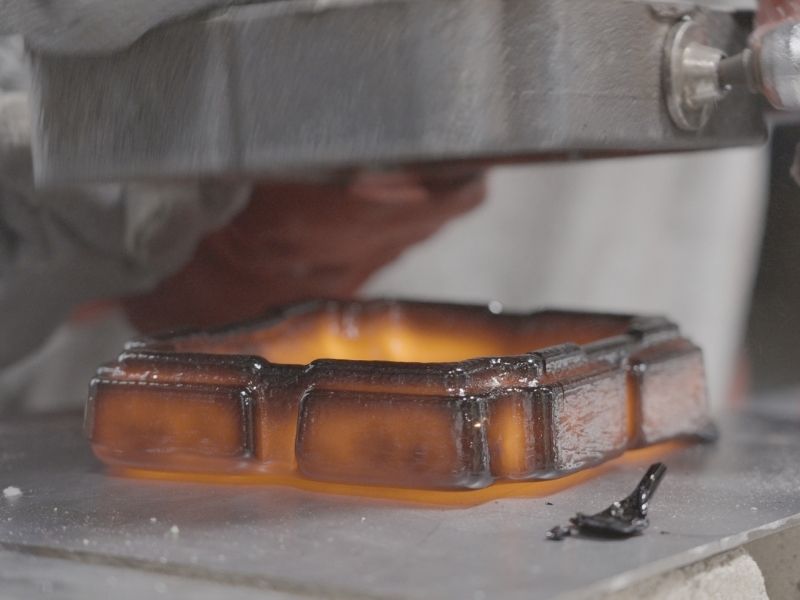
Lava takes a new shape. A freshly cast piece designed by Max Greiner emerges from its mould at Lava Show, still glowing with heat before controlled cooling helps prevent it from cracking.
The Real Challenge: Cooling Lava Without Breaking It
Pouring molten lava into a mould is only part of the process. Getting the finished object to survive is another challenge entirely.
As Max explains, lava can develop internal stresses as it cools, causing an object to crack or shatter.
Working with Piotr Slabik, Lava Show’s Head of Melting, Max developed a controlled cooling process using a separate kiln. This process, known as annealing, helps release internal stresses as the material cools.
Finding the right programme required repeated experiments. Cooling too quickly caused problems, but simply slowing everything down was not the answer either. Max describes how crystal growth during slower cooling also affected the results.
Each attempt provided information for the next. A broken object became a clue about what needed to change.
A Dance Behind the Scenes
Working with molten lava requires preparation, coordination and an understanding of how the material behaves.
Max describes a short window in which the team must catch the lava in a mould, release the newly formed object and transfer it into the cooling kiln.
Watching the team work, Iain was reminded of ballroom dancing on a space station: people in protective suits moving around one another in a carefully timed sequence.
That practical experience matters. Through his work as a Lava Melter, Max has learned to recognise changes in the lava’s flow and adapt to them.
The project draws on technical research, but much of the learning happens through observing, making and trying again.
Why Make a Lava Hot Dog Holder?
The first objects include vases, trays and an especially playful example: a hot dog holder.

Iceland’s favourite snack meets its volcanic landscape. These lava hot dog holders are part of designer and Lava Melter Max Greiner’s experiments in turning molten basalt into everyday objects at Lava Show.
Each explores a different question. How thick can an object be? How thin? Which shapes can the material hold, and how much detail can a mould capture?
Some of their forms take inspiration from packaging used to transport imported goods. It is an unexpected reference for objects made locally from Icelandic volcanic material, and it reflects Max’s interest in the relationship between local production and imports.

From molten rock to objects with character. Max Greiner’s experimental lava collection explores the shapes, textures and colours achievable through casting and controlled cooling at Lava Show.
These pieces are prototypes that demonstrate possibilities. Developing practical objects that people would want to use or take home is part of the next stage.
Could Lava Become a New Icelandic Craft?
Casting basalt already has industrial applications. Max’s interest lies in exploring a smaller, more hands-on approach, with objects made individually through collaboration between designers, melters and craftspeople.
He describes an early experiment with a local glassblower who shaped a small flower from molten lava without using a mould. They successfully stabilised it through controlled cooling, suggesting possibilities beyond casting alone.
For Max, the project is also about strengthening connections between people and their surroundings. An object made from Icelandic lava can carry a story about the landscape, the people who shaped it and the knowledge developed along the way.
Future ideas discussed in the episode range from decorative objects to tiles for geothermal pools. There is still plenty to investigate, but the first experiments have opened the door.
Listen to the Full Episode
What does it feel like to work beside molten lava? How do you learn from an object that falls apart? And what might we make from lava next?
Join Max, Iain and Ragnhildur for a conversation that takes Lava Academy into the world of design, experimentation and emerging craftsmanship.
Listen to the full episode through your favourite podcast app.
Links related to Max's Greiner work
Experience the Material That Started It All
At Lava Show, the material behind Max’s experiments flows right before your eyes.
Watch real molten lava, feel its intense heat and discover how it behaves as it cools. Visit us in Reykjavík or Vík to experience Iceland’s volcanic power—and perhaps leave seeing lava a little differently.