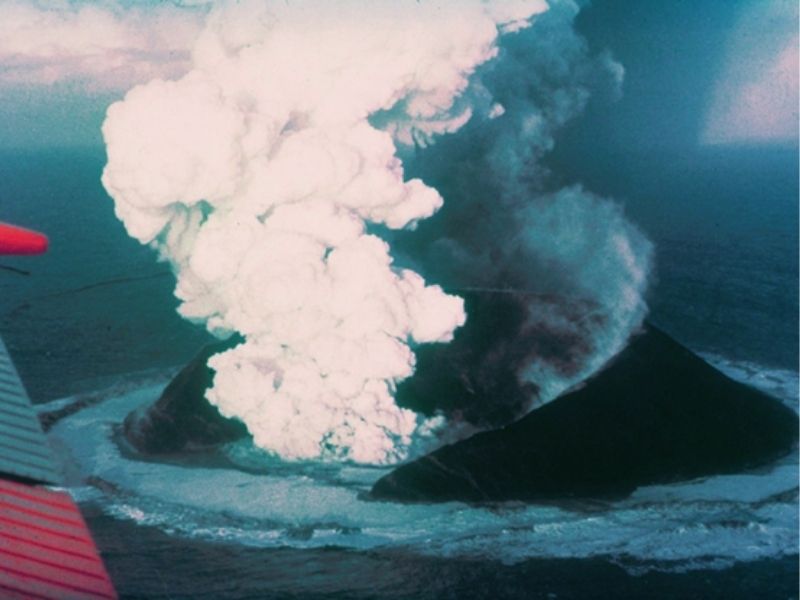
An overhead view of Surtsey, a volcanic eruption on a new island in the sea off the coast of Iceland. Ash and steam pour out of the newly formed volcanic crater and basalt begins to form an island.

火山

Surtsey: The Birth of an Island and a Living Laboratory

Explore the formation of Surtsey, a volcanic island born in 1963, and one of the world’s most important natural laboratories.

In November 1963, the North Atlantic did something rare enough to feel almost mythical - it created new land before human eyes. Just off the southern coast of Iceland, the ocean began to boil, steam rose in violent bursts, and within days, a black volcanic island broke the water’s surface. This was Surtsey, a place where Earth’s internal forces became visible, tangible, and measurable in real time, where once nothing existed.

Unlike most volcanic landscapes, which we inherit long after their formation, Surtsey was witnessed from birth. Scientists (and locals) watched it grow, stabilize, erode, and ultimately transform into something even more remarkable: one of the most carefully protected natural laboratories on Earth.

Quick Facts about the Surtsey Eruption

  • Eruption Dates: 1963–1967

  • Location: Off the south coast of Iceland, in the Vestmannaeyjar archipelago

  • Volcanic System: Vestmannaeyjar volcanic system, the southern extent of the Eastern Volcanic System

  • Volcanic type: Embryonic central volcano, with associated, less-developed fissure swarm

  • Eruption Type: Phreatomagmatic explosive (Surtseyan, 10 km column), evolving into effusive

  • Lava (island) Area: ~1.3 km² (initially larger; reduced by erosion)

  • Lava & Tephra Volume: ~1 km³ (combined erupted material)

  • Lava Type: Basaltic

  • Gas Emissions: Dominantly water vapor, CO₂, SO₂ typical of basaltic eruptions

  • Significance: Formation of a new island observed in real time; long-term ecological and geological research site


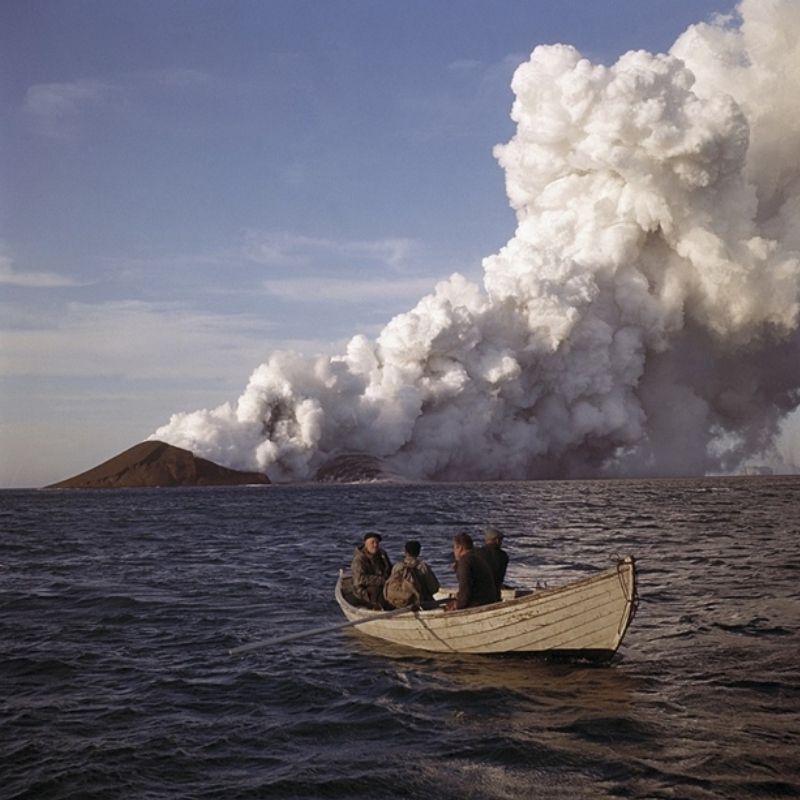
Three men in a row boat form a film crew and approach the erupting volcano of Surtsey, part of the Vestmannaeyjar volcanic system, in hopes to document the new island and the lava.

A film crew in the 1960s approaches Surtsey as it erupts. (Photo from IMO and Sigurgeir Jónasson)


A Violent Birth from the Sea

Surtsey’s story begins beneath the ocean floor, where magma rose from deep within the earth’s crust and intersected with seawater. Given some seismic readings, the eruption probably was occurring for at least a week before the eruption reached above the sea’s surface. This water-magma interaction triggered a highly explosive eruption style known as a Surtseyan eruption, named, fittingly, literally, after this very island.

When magma erupts and meets water, the result is explosive on a sometimes-dramatic scale. Superheated steam expands violently, shattering magma into fine ash and ejecting it skyward in dense, dark plumes. Early photographs of Surtsey show towering columns of ash and steam, punctuated by ash-static lightning.

Over weeks and months, these explosions built a tephra cone that eventually poked out of the sea and started forming topography above the water. Then, as the volcanic vents became more isolated from seawater as it grew higher and wider, activity transitioned to quieter, effusive lava flows.

These effusive basaltic lavas spread across the new island, hardening into more erosion-resistant rock as they came into contact with cold water. (This is a process called palagonization, altering basalt through low-temperature hydration.) This process armored the island, allowing it to persist where many similar eruptions have failed.

Geologically, Surtsey is a textbook example of how an eruption environment can control volcanic behavior. The same magma produced both explosive fragmentation and gentle lava flows. But, simply depending on whether water was present changed the entire character of the volcano. Few places on Earth illustrate this transition so clearly.

From Barren Landscape to Scientific Treasure

Almost as soon as Surtsey emerged, it became clear that it needed protection. Not from natural forces and volcanic explosions, but from us.

In 1965, while the eruption was still ongoing, authorities restricted access to the island. The goal was simple but ambitious: allow nature to take its course without human interference. No seeds planted, no animals introduced, no footprints left unnecessarily. Scientists would observe – but not alter – the experiment.

This decision transformed Surtsey into one of the most valuable ecological study sites in the world. Over the decades, researchers have documented the gradual colonization of the island: first by microbes and fungi, then by mosses and lichens, followed by insects, birds, and eventually more complex plant communities.

Seabirds played a particularly important role. By nesting on the island, they transported nutrients inland, accelerating soil development and making it possible for vegetation to take hold. What began as sterile volcanic rock slowly transitioned into a functioning ecosystem.

Recognition of Surtsey’s importance culminated in its designation as a UNESCO World Heritage Site by UNESCO in 2008. Today, access remains strictly limited to a few, credentialed researchers, ensuring that the island continues to serve as an untouched baseline for studying ecological growth and evolution.

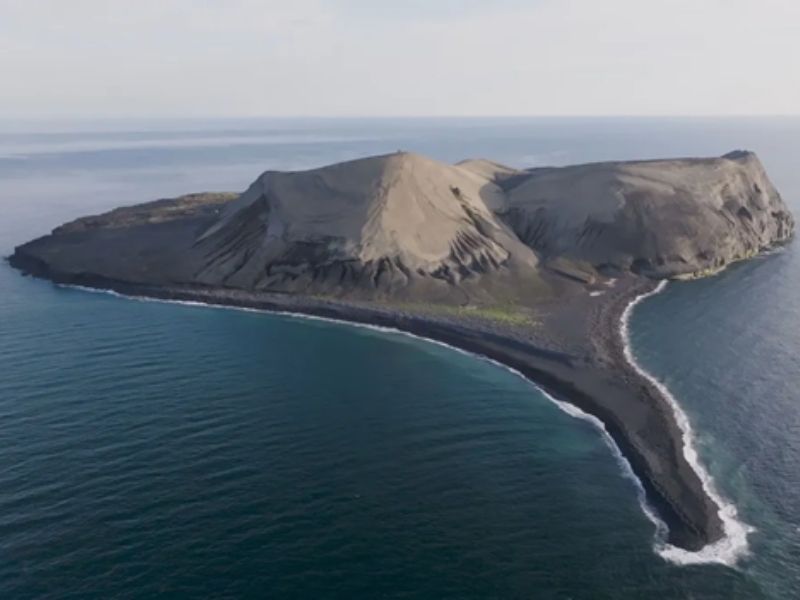
The volcanic island of Surtsey sits in the ocean as an isolated basalt volcano, off the coast of Iceland, with dramatic palagonite cliffs and new plant formation.

Surtsey in the modern day. What the island looks like now, with its dramatic volcanic crater and lava tongue preserved, and moss and plants growing. (Picture from RÚV and Magnús Atli Magnússon)

What Happens Next? Future Volcanic Activity and Lava-Spotting Outlook

From a geological perspective, Surtsey’s dramatic birth does not necessarily mean it has an equally dramatic future. The eruption that formed Surtsey between 1963 and 1967 was likely the result of a localized magma intrusion along the Vestmannaeyjar volcanic system, itself part of the broader Eastern Volcanic Zone. These systems are still active, but not in a way that suggests Surtsey itself is “due” for another eruption (read more here about what being “overdue” means geologically).

In fact, eruptions in volcanic systems like Vestmannaeyjar tend to migrate along fissures rather than repeatedly erupting from the exact same location The 1973 eruption on Heimaey, just a decade after Surtsey formed, is a perfect example. Magma found a new pathway, reminding us that while the system remains active, its behavior is spatially unpredictable.

Looking at the bigger picture, Iceland’s Eastern Volcanic Zone is one of the most volcanically productive regions on Earth. It is where the Mid-Atlantic Ridge rises above sea level and interacts with a deep mantle plume. Magma is continuously being generated and transported through the crust, feeding volcanic systems from Katla to Grímsvötn and out to the offshore Vestmannaeyjar islands.

So could Surtsey erupt again? It’s possible, but unlikely in the sense most people imagine. A future eruption would be more likely to occur somewhere nearby along the same lineation of fissures rather than directly beneath the existing island. Over long timescales, new islands could form, while older ones, like Surtsey, continue to erode and grow greener.

As for phreatomagmatic eruptions, they remain an inherent part of Iceland’s volcanic behavior. Anywhere magma interacts with water (like seawater, groundwater, or glacial ice), there is potential for explosive activity. However, this does not translate into widespread danger for the general population. These eruptions are typically localized and well-monitored by the Icelandic Meteorological Office, which tracks seismic activity, ground deformation, and gas emissions in real time.

Quick Q&A Section about Surtsey

Q: Can you visit Surtsey?

A: No. Access is strictly restricted to pre-approved scientists to preserve its pristine ecosystem.

Q: Is the island still growing?

A: No. The eruption ended in 1967. Today, erosion is gradually shrinking the island.

Q: Why didn’t it disappear like other volcanic islands?

A: Later lava flows hardened the island, turning basalt into palagonite, protecting it from wave erosion.

Q: What was the first life to appear there?

A: Microorganisms and fungi arrived first, carried by wind, followed by plants and seabirds.

Q: Where did the name “Surtsey” come from?

A: It’s named after Surtr, a fire giant from Norse mythology.

The Final Word on Surtsey

Surtsey is more than just a volcanic island to us now. It is a moment in Earth’s history that we were fortunate enough to witness from the very beginning, and that we had the foresight quickly enough to preserve and study. Its explosive birth revealed the raw mechanics of volcanic creation, while its careful protection has allowed scientists to research the slow, intricate process of life taking hold where none existed previously.

Few places capture both the violence of planetary formation and the slow persistence of biology quite like Surtsey. It is a reminder that even in a world we think we understand, entirely new landscapes (and new stories!) can still emerge from the depths.

If you would like to hear more about volcano stories and see basalt lava in action, and even how it interacts with water and ice, the Lava Show is the perfect place to learn more.

Read More about the Surtsey Eruption

Listen to the Lava Academy Podcast

Discover the Lava Academy Podcast where you get in-depth conversation foscusing on the wonderful world of geology, volcanos and of course lava!

This article is written by geologist Jessica Poteet. Listen to the interview with her on the Lava Academy Podcast.

溶岩ショー 最新ニュースをお届け

今すぐ登録して、世界一アツい体験をあなたの受信箱へ!

溶岩ショー 最新ニュースをお届け

今すぐ登録して、世界一アツい体験をあなたの受信箱へ!

溶岩ショー 最新ニュースをお届け

今すぐ登録して、世界一アツい体験をあなたの受信箱へ!

レイキャヴィーク

Fiskislóð 73, 101 Reykjavík

電話番号:+(354) 553 0005

ヴィーク

SNSで話題の溶岩ショー

溶岩ショー

VSK番号: 132003

ケニータラ: 4607161010

レイキャヴィーク

Fiskislóð 73, 101 Reykjavík

電話番号:+(354) 553 0005

ヴィーク

SNSで話題の溶岩ショー

溶岩ショー

VSK番号: 132003

ケニータラ: 4607161010

レイキャヴィーク

Fiskislóð 73, 101 Reykjavík

電話番号:+(354) 553 0005

ヴィーク

SNSで楽しむラバショー

溶岩ショー

VSK番号: 132003

ケニータラ: 4607161010