Description of the Lava Show
Introduction
La société Lavashow a été fondée par un couple islandais, Julíus et Ragga, en 2018. Ils ont été inspirés par l'éruption d'Eyjafjallajökull et de Fimmvörðuháls en 2010. L'éruption d'Eyjafjallajökull est devenue connue dans le monde entier pour deux raisons : l'immense nuage de cendres qui en a résulté, bloquant tout le trafic aérien en Europe, ainsi que son nom imprononçable pour ceux qui ne parlent pas islandais. Ce volcan a finalement reçu un surnom, E-15. E pour la première lettre de son nom, et 15 pour les quinze autres lettres.
Bien que cette éruption soit la plus célèbre de 2010, un volcan plus petit est également entré en éruption 3 semaines plus tôt, près de Fimmvörðuháls. Cette petite éruption était connue comme une “éruption touristique”, ce qui signifie que Julíus et Ragga ont pu la voir de leurs propres yeux. Ils ont alors assisté à la plus grande cascade de lave jamais enregistrée, haute de 200 mètres. Fascinés par ce qu'ils ont vu, ils ont voulu que tout le monde puisse vivre une expérience aussi formidable, mais cela n'est pas toujours possible car les volcans sont entourés de dangers et de risques. Les volcans sont imprévisibles, il est impossible de prédire exactement quand et où ils entreront en éruption. Les volcans sont également très dangereux, avec des risques fréquents tels que : la lave, les gaz toxiques, les glissements de terrain, les inondations, les feux de forêt, les explosions...
Voici quelques raisons pour lesquelles la plupart des gens ne seront pas capables d'observer une éruption directement. Julíus et Ragga ont donc créé Lavashow pour que tout le monde puisse vivre l'expérience de voir la lave couler devant leurs yeux, sans tous les risques associés, dans un environnement contrôlé.
Vidéo
After this introduction, you will watch a video that explains geological facts about Iceland, the history of the Vikings and their arrival at the end of the 9th century, as well as some catastrophic eruptions that have occurred in Iceland since its formation. The volcanoes in the video you are about to see are quite dramatic. It's not meant to scare you, but to show you the incredible power they can have. All Icelandic volcanoes are closely monitored, and we know when something might happen, so we prepare accordingly. The three main things we monitor are toxic gases, ground deformations, and earthquakes. This data is fed into a volcano assessment system, where we can check online what each volcano is doing at any given moment.
Flow of lava
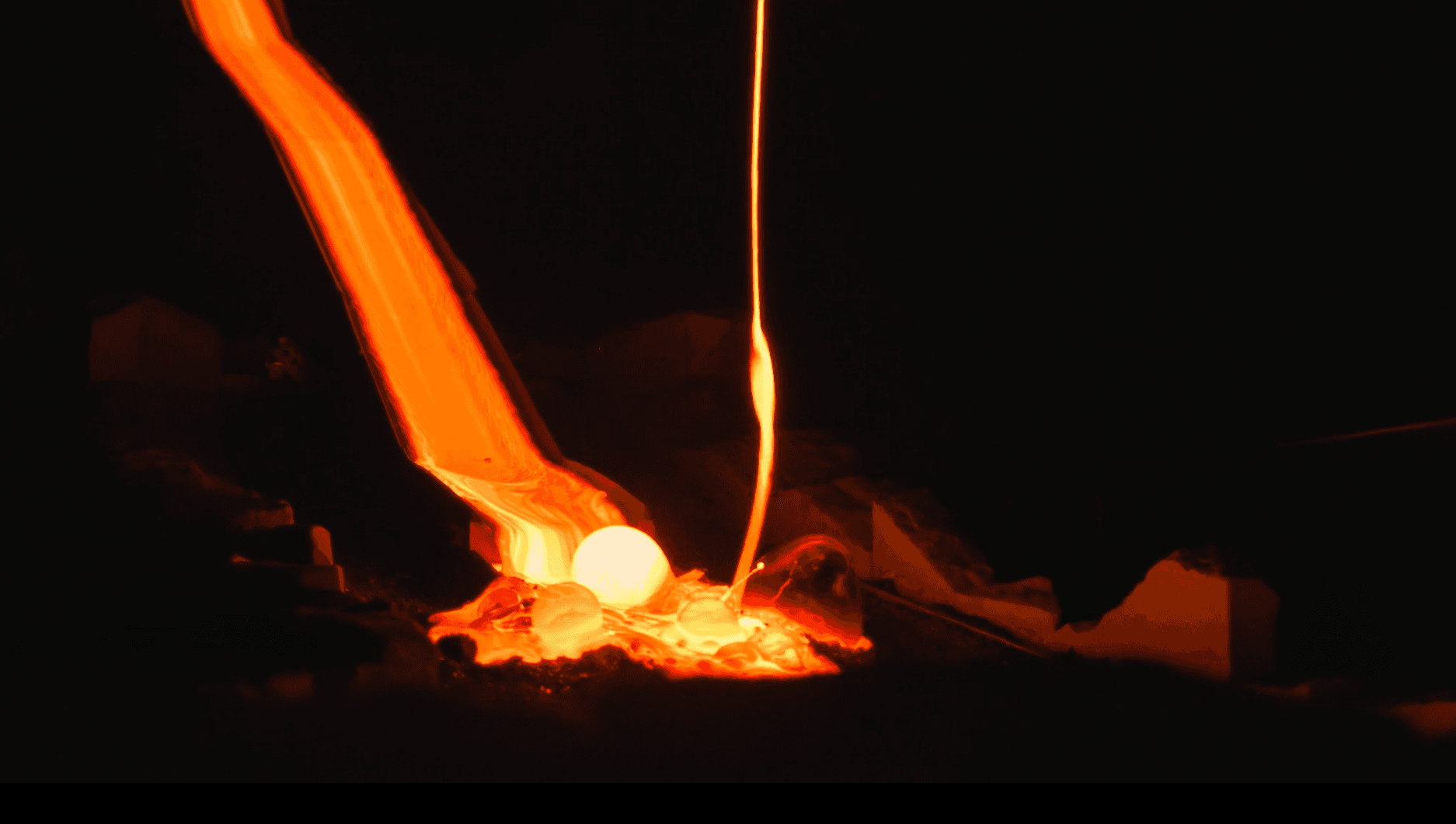
The lava will enter the room through this hole in the wall and flow down this slide. The Lava enters the room at 1100°C. At the end of the slide, we have a buried ice block. We put it here because about half of the volcanoes in Iceland are covered by glaciers, so the reaction between lava and ice is common. What we hope to see here is a small steam explosion, the ice transforms into steam which makes lava bubbles. There are two types of lava flows, A’a flows, and pahoehoe flows. A’a flows are cooler in temperature, black in color, and very thick. This is not the type of lava we will see; what you're going to see today is a pahoehoe flow, it is much hotter, fluid, with a bright orange color. At the bottom of the slide is basaltic tephra dating from the Katla eruption in 1918, which is also our original material, this is what we put in the furnace to make our lava.
You will find safety glasses on your seat, you are asked to put them on after the video when the lava enters the room. Please keep them on until you leave the room at the very end. They are necessary to keep you safe. You are allowed to take photos and videos, but keep the flash off.
The show
The cracks and creaks you may hear are made by lava solidifying. As it solidifies, the lava shrinks and contracts, causing these sounds.
While the lava hardens, it transforms into volcanic glass. Volcanic glass is formed when lava is cooled very quickly, so quickly that no crystals have time to form. Volcanic glass is different from regular glass. When lava cools very rapidly, the elements that make up the lava all join to what is most prevalent in the lava, silica (SiO2). When everything mixes with the silica, the whole resembles glass. Silica is the main ingredient in both regular and volcanic glass. The black color is caused by magnesium and iron.
When the lava is broken into pieces, you’ll be able to see what it looks like inside. The lava is still red, shiny, and fluid, while the exterior is black and hard, which creates this insulating effect. The outer part cools and becomes hard, trapping heat inside the central part which thus remains warm for a very long time.
The original material of the lava comes from the eruption of Katla in 1918. The geological term for this material is “basaltic tephra”. Basalt is the type of lava it is, and Tephra means “exploded rock fragment”. This tephra was created when the Katla volcano erupted under the Myrdalsjökull glacier. Myrdalsjökull is twice the size of Reykjavik and more than 700 meters thick. When Katla erupted under the ice, it caused a huge steam explosion, vaporizing the lava into tephra. Then there was a glacial flood, all the melted water, ice, and tephra came out of the glacier. The water went to the ocean. What was left behind are the deserts and black sand beaches. From there, we go to where the remains of this eruption are, collect tephra, put it in the furnace, and poof! Brand new lava.
Les cheveux de Pele sont de fins fils de lave formés par la nature, lorsque la lave s'écoule d'une falaise et est transportée par le vent. Ce sont de très petits fils délicats, ce qui les rend très difficiles à trouver dans la nature.
A block of ice will be placed on top of the lava. The lava will start to behave differently, with steam creeping into the lava causing it to swell. See how the top of the lava begins to solidify. When this layer becomes solid, the steam inflates the lava like a balloon.
Lava is a good heat insulator; it insulates itself. Even though the exterior cools and solidifies quickly, the interior can remain liquid and retain its heat for a very long time. When this happens, lava tunnels can form in nature. When a lava river is formed in nature, the outer part of this river hardens, causing the central part to remain liquid and flow further. Eventually, when the volcano stops, the liquid lava leaves the hardened part, leaving behind the solid insulating layer, which forms a lava tunnel.
The cracks and creaks you might hear are made by the lava as it solidifies. As it solidifies, the lava shrinks and contracts, causing these noises.
As lava hardens, it transforms into volcanic glass. Volcanic glass is formed when lava cools very quickly, so quickly that no crystals have time to form. Volcanic glass is different from ordinary glass. When lava cools rapidly, the elements that make up the lava all combine with what is most present in the lava, silica (SiO2). When everything mixes with silica, the whole resembles glass. Silica is the main ingredient in both ordinary glass and volcanic glass. The black color is caused by magnesium and iron.
Lorsque la lave est brisée en morceaux, vous pouvez voir à quoi cela ressemble à l'intérieur. La lave est encore rouge, brillante et fluide, tandis que l'extérieur est noir et dur, ce qui crée cet effet isolant. La partie extérieure se refroidit et devient dure, ce qui emprisonne la chaleur à l'intérieur, qui reste donc chaude très longtemps.
Le matériau d'origine de la lave provient de l'éruption du Katla en 1918. Le terme géologique pour cette matière est “téphra basaltique”. Le Basalte est le type de lave en question, et Téfra signifie “morceau de roche explosée”. Ce téphra a été créé lorsque le volcan Katla est entré en éruption sous le glacier Mýrdalsjökull. Le Mýrdalsjökull est deux fois plus grand que Reykjavik et a plus de 700 mètres d'épaisseur. Quand Katla est entré en éruption sous la glace, cela a provoqué une énorme explosion de vapeur, vaporisant la lave en téphra. Ensuite, il y a eu une inondation glaciaire, où toute l'eau fondue, la glace et le téphra sont sortis du glacier. L'eau s'est déversée jusqu'à l'océan. Ce qui est resté, ce sont les déserts et les plages de sable noir. À partir de là, nous allons là où les vestiges de cette éruption se trouvent, ramassons du téphra, le mettons dans le fourneau, et pouf ! Une nouvelle lave toute fraîche.