Volcanoes
Magma versus Lava: What is the difference?
Think magma and lava are the same thing? Think again! Don’t make this mistake when talking about volcanoes.
Many people interchange the terms lava and magma when talking about volcanoes. It’s an easy mistake to make for the uninitiated; but today that all changes! Let’s learn the difference between these two key molten forces that shape volcanoes (and the Icelandic landscape).
First, some straightforward definitions:
Magma: magma is molten rock that is below the earth’s surface. It might erupt, it might not, but any melted or partially melted material (collection of minerals, rocks, and gases) underground is magma.
Lava: lava is molten or solidified molten rock that is on the earth’s surface. It may be flowing, or may be hardened, but any erupted, now- or once-melted material above ground is lava.
Easy!
Simply stated, magma and lava are basically the same thing, but one is below ground and the other is above ground. There are some key differences, and we will dive deeper with these nuances below. But when talking about volcanoes, magma is the molten stuff waiting to erupt below the earth’s surface and lava is the molten or solidified stuff that has already erupted.
Magma becomes lava the second it erupts.
What are the detailed differences between magma and lava?
The process of a volcanic eruption, whether effusive or explosive, is a dramatic, intense experience. Magma sits under high amounts of pressure, sometimes deep underground, waiting to rush to the surface. As it erupts, magma releases its pressure with either rumbling, towering fountains of lava (effusive eruption) or ferocious, loud, chunky blasts of lava (explosive eruption). It will create turbulent, noisy forces of earth shaking and breaking, with noxious gases, scalding flows of molten rock, almost super-sonic clouds of scorching ash, and a potential for deadly floods and/or lightning. While magma and lava are almost the same material, the staggering process of when one becomes the other creates subtle, but important, differences.
Although magma and lava are often defined simply by over- or underground location, the difference between them goes far deeper than its residential depth. Magma is a mixture of molten rock, crystals, and dissolved gases (i.e. melted material discussed above) stored under immense pressure within the Earth’s crust or mantle. Whereas lava is that same material after it has erupted and begun interacting with the surface environment.
In-depth magma versus lava description from a Lava Show geoscientist:
This is how geologists at Lava Show geologist respond when we are asked to deep dive into the science of the differences between magma and lava; here is what they said:
“As magma rises and becomes lava, the sudden drop in pressure allows dissolved gases such as water vapor and carbon dioxide to escape, often driving explosive eruptions or creating gas bubbles within flowing lava. This loss of gases, along with rapid cooling from contact with air, water, or ice, causes lava to crystallize more quickly and often become more viscous as it loses heat. Underground, magma may remain partially molten for thousands of years because surrounding rock insulates it and pressure keeps gases dissolved; at the surface, lava cools much faster, forming everything from glassy volcanic rock to crystalline, rock-like lava fields. While their temperatures are broadly similar, typically ranging from about 700°C to over 1,200°C depending on composition, their behavior can be dramatically different: magma may deform slowly and remain mobile over geological timescales, while lava must flow, fracture, and solidify under much lower pressures and shorter periods of time. In essence, lava is not a different substance from magma; it is magma that has crossed a critical boundary, losing pressure, releasing gases, cooling rapidly, and adapting to a completely new environment.”
Questions and Answers about Magma versus Lava
But are magma and lava truly the same exact material, just at different pressures in a different location?
Not always. If magma sits in the earth’s crust for a long time, it will begin to solidify and develop crystals, called a magma mush. If this process happens, the magma chamber will begin to become stratified, or layered, with different geochemically different layers. If an eruption then occurs, the more solidified magma will stay put in the magma chamber or sill, and lava that erupts will be geochemically different from the magma that remains underground.
I have heard about extrusive and intrusive rocks: how does this relate to magma versus lava?
Simply put, intrusive rocks are magmatic rocks that solidify underground and stay un-erupted. (i.e. intrusive is IN-side the earth) Extrusive rocks are volcanic rocks that have erupted and solidify above ground (i.e. extrusive has EX-ited the earth)
Once lava cools and hardens, is it still called lava?
Yes. This can become confusing, because lava can be fast-moving, molten hot rock or it can be the solidified remains of those flowing, molten rocks. Meaning, lava can be one minute old, one month old, or one million years old!
Since it is deep underground, has anyone ever seen magma?
While humans have never set eyes directly on molten magma deep within the earth’s crust, we have encountered it while still molten.
Several wells within Iceland’s Krafla geothermal field have intersected magma but of course the minute that magma rushes up the borehole and flows out, it becomes lava.
Scientists flash-froze some magma in one deep borehole experiment at Krafla, creating magma glass, and then bringing it to the surface. There is a philosophical argument to be had to say if this quenched magma once at the surface is lava or not.
Of course, we can see the eroded remains of solidified magma in mountain ranges around the world, where sills, dikes, volcanic pipes, and batholiths have been uplifted to the surface over time and exposed to see millions of years later.
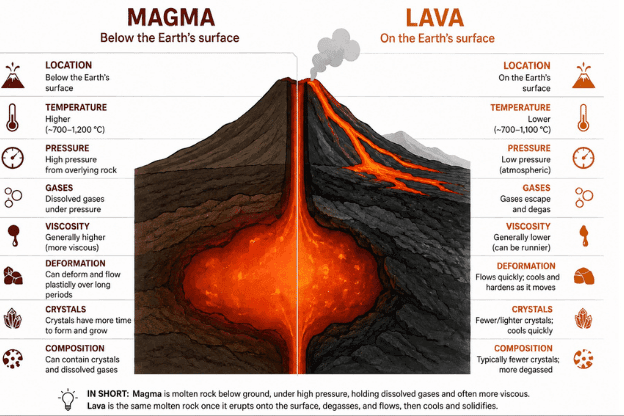
Magma versus lava: magma is molten rock beneath the Earth’s surface; once it erupts, it becomes lava. The change in pressure and environment affects its gases, viscosity, cooling, movement, and crystal formation.
Is it really that simple, between magma and lava?
To help you remember these concepts, in simplest of terms: yes, it really is that simple! Magma is molten rock under ground and under pressure, carrying the hidden story of everything happening deep beneath our feet as tectonic plates move and new crust comes to life. Then it erupts, the pressure drops, gases escape, and a new chapter begins. That same molten material is now lava – flowing, cooling, and becoming newborn earth right before our eyes. Magma is the underground chapter; lava is the story turning the page and writing a new chapter of the formation of our earth.
Experience Real Molten Lava
Magma remains hidden beneath the Earth’s surface, but once it erupts, it becomes lava—releasing gases, losing heat and beginning to form new land. At Lava Show, you can safely witness real molten lava flowing just metres away. Feel its intense heat, hear it crackle as it cools and watch it solidify before your eyes, bringing the science behind magma and lava vividly to life.
Plan your visit:
Experience Lava Show Reykjavík – Watch real molten lava flow in Iceland’s capital.
Experience Lava Show Vík – Experience the world’s only live lava show on Iceland’s South Coast.
Listen to the Lava Academy Podcast
Discover the Lava Academy Podcast where you get in-depth conversation focusing on the wonderful world of geology, volcanos and of course lava!
This article is written by geologist Jessica Poteet. Listen to the interview with her on the Lava Academy Podcast.