Vulcões
Muito Barulho por Causa de Terremotos: Compreendendo os Sistemas Vulcânicos de Eldey e Reykjanes
Dois sistemas vulcânicos, ambos de igual dignidade, no belo sudoeste da Islândia, onde situamos o nosso cenário. Mas o que há num nome, e por que razão estes dois sistemas vulcânicos continuam a ser confundidos nas redes sociais e nos meios de comunicação social?
Eromper ou não eromper: eis a questão no sistema vulcânico Svartsengi, que aguarda atualmente uma potencial décima erupção em dois anos e meio, à medida que a acumulação de magma atinge os 30 milhões de m3 (o equivalente a 30 mil milhões de litros!) abaixo da mundialmente famosa Lagoa Azul. Mas se tem estado atento aos mapas de sismos da Islândia ultimamente, poderá ter notado que tem havido muita atividade sísmica no mar, em torno da ponta ocidental da Península de Reykjanes e ao longo da Dorsal de Reykjanes.
E se tem acompanhado as manchetes, os vlogs ou as atualizações nas redes sociais, também poderá ter visto estes sismos descritos como ocorrendo "em Eldey", "em Reykjanes" ou simplesmente "perto da Península de Reykjanes". Estes termos podem parecer geograficamente intercambiáveis; mas, geologicamente, não o são!
Até que ponto o sistema vulcânico Eldey está ligado aos sistemas vizinhos?
A Península de Reykjanes na Islândia e a sua extensão da dorsal ao largo contêm vários sistemas vulcânicos separados, cada um com os seus próprios enxames de fissuras, história eruptiva e sistema de canalização superficial (embora muitos destes sistemas possam estar ligados a um nível mais profundo, mas isso é uma discussão para outro artigo). O sistema vulcânico Eldey e o sistema vulcânico Reykjanes são dois deles.
São vizinhos. São ambos basálticos. Ambos situam-se no mesmo limite de placa tectónica. E ambos estendem-se ou estão localizados inteiramente ao largo. Mas não são o mesmo sistema vulcânico, e essa distinção torna-se particularmente importante quando tentamos interpretar enxames de sismos e fazemos a pergunta que todos querem realmente ver respondida: o magma está a mover-se e poderá estar a caminho uma erupção?
A resposta curta é que algumas evidências apontam nessa direção, enquanto outras claramente não estão ligadas a vulcões. A resposta mais longa é muito mais interessante e complicada, como a maioria das coisas na geologia. Vamos explorar estes dois sistemas vulcânicos, a margem de placa onde se situam e a agitação sísmica que temos observado nos últimos anos.
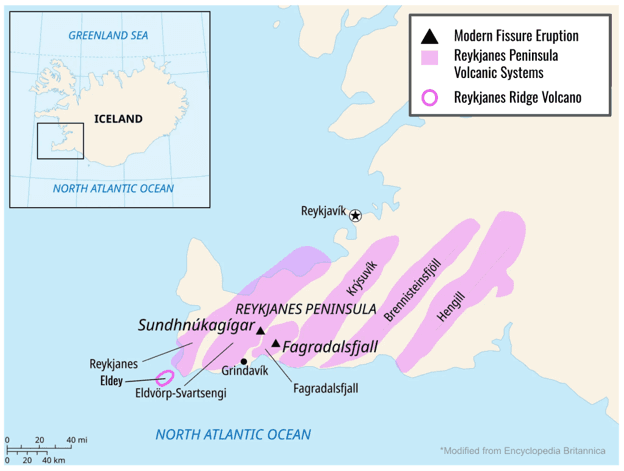
Mapa dos sistemas vulcânicos da Península de Reykjanes, bem como o sistema ao largo de Eldey com um contorno cor-de-rosa.
A Dorsal de Reykjanes: a linha condutora que une os sistemas vulcânicos do sudoeste da Islândia
A Dorsal de Reykjanes é a expressão submarina da Dorsal Mesoatlântica (MAR) no sudoeste da Islândia, ou seja, uma secção do sistema global de dorsais oceânicas onde as placas Norte-Americana e Eurasiática se estão a afastar. À medida que a dorsal se aproxima da Islândia, eleva-se em direção à superfície e acaba por emergir na Península de Reykjanes, tornando a península essencialmente a continuação terrestre de uma dorsal de expansão oceânica. Mas a transição não é tão simples como uma linha que continua nitidamente do mar para a terra. Ao largo, a Dorsal de Reykjanes é dominada pela extensão e expansão do fundo do mar; na península, o limite das placas torna-se mais oblíquo, produzindo uma combinação de falhas normais extensivas e movimento de rejeito horizontal. Esta geometria complexa criou uma série de sistemas vulcânicos alongados e enxames de fissuras que se estendem pela península, enquanto ao largo a atividade vulcânica reflete a arquitetura geológica típica da Dorsal Mesoatlântica.
É fundamental notar que esta dorsal pode registar muita atividade sísmica de natureza puramente tectónica à medida que as duas grandes placas se afastam uma da outra, e muitos dos sismos ao longo desta dorsal não têm ligações diretas ao movimento do magma ou à formação de vulcões.
Os Sistemas Vulcânicos da Península de Reykjanes: uma nova era de vulcanismo na região
Se tem acompanhado as notícias sobre os vulcões da Islândia, sabe que a Península de Reykjanes entrou numa nova fase ativa de atividade eruptiva, com doze erupções entre dois sistemas vulcânicos nos últimos cinco anos. Os sistemas vulcânicos ao longo da península parecem estar todos geneticamente ligados nas profundezas da crosta terrestre, entrando em erupção em ciclos conjuntos de atividade intensa durante 100-200 anos, seguidos de 800-1000 anos de quietude. Com as erupções em Fagradalsfjall seguidas de Svartsengi, é evidente que entrámos num novo capítulo de vulcanismo ativo.
A grande questão é: qual o sistema que irá entrar em erupção a seguir e quando?
Tem havido uma onda de atividade sísmica em quase todos os outros sistemas da Península de Reykjanes, mas pode ser difícil distinguir entre o movimento magmático e tectónico dentro da crosta ao analisar apenas um único sismo. Os geocientistas precisam de múltiplos pontos de dados ao longo de um período de tempo para poderem propor tendências e atribuir hipóteses à sismicidade que observam.
Duas dessas áreas sismicamente ativas ao longo da Dorsal e da Península de Reykjanes são os vizinhos Sistema Vulcânico Reykjanes e Sistema Vulcânico Eldey.
O Sistema Vulcânico Reykjanes
O sistema vulcânico Reykjanes é o sistema vulcânico mais ocidental da península. Não tem um vulcão central. Em vez disso, consiste principalmente de enxames de fissuras que se estendem aproximadamente de sudoeste para nordeste, com porções tanto em terra como ao largo. As lavas deste sistema moldam a ponta sudoeste da península em direção ao oceano, e muitos fluxos de lava foram perdidos para as ondas, quer através de erosão, quer através de deposição subaquática.
As suas fissuras produziram fluxos de lava, alinhamentos de crateras, cones de escória e cones de tufo, enquanto as erupções ao largo deixaram camadas de tefra que podem ser identificadas nos solos em terra. Pelo menos 15 camadas de tefra foram associadas a erupções da parte ao largo do sistema de Reykjanes.
Estas não foram uma única erupção; esta é uma distinção importante. Quando os vulcanólogos locais dizem que o sistema de Reykjanes "teve a sua última erupção há 800 anos", é tentador imaginar um vulcão que entrou em erupção uma vez em 1210 e depois se desligou. Não é isso que o registo geológico sugere.
O sistema de Reykjanes, juntamente com os seus sistemas homólogos ao longo da península, parece ser capaz de entrar em períodos de atividade eruptiva repetida com múltiplas erupções por cada episódio ativo.
O Sistema Vulcânico Eldey
O sistema vulcânico Eldey situa-se na parte mais setentrional da Dorsal de Reykjanes, ao largo a sudoeste da Península de Reykjanes. Ao contrário dos sistemas maioritariamente terrestres situados mais a leste ao longo da península, Eldey é predominantemente submarino. O sistema inclui a ilha de Eldey e vários pequenos ilhéus, mas a maior parte da sua paisagem vulcânica está escondida sob o oceano.
Isso torna Eldey fascinante... e frustrante.
Eldey é um sistema de conduta de fissura submarina cuja atividade caraterística são erupções basálticas submarinas explosivas. Foram identificadas seis pequenas erupções no sistema durante aproximadamente os últimos 1100 anos, sendo a mais recente em 1926.
Os registos históricos sugerem erupções ou suspeitas de erupções em redor de Eldey em 1211, 1340, 1422, 1879, 1884 e 1926, embora alguns desses eventos estejam consideravelmente melhor documentados do que outros e algumas localizações históricas sejam incertas. Vários produziram ilhas temporárias que foram posteriormente destruídas pelas águas do Atlântico Norte.
Essa é uma das características definidoras de Eldey: os cientistas sabem que entra em erupção, e sabem que tem entrado em erupção com muito mais frequência do que os seus vizinhos nos tempos modernos, mas o facto de o sistema estar totalmente debaixo de água significa que ninguém consegue ver diretamente o que está a acontecer.
A maior parte do sistema está profundamente submersa, e as suas erupções podem ser de curta duração e difíceis de observar diretamente. O registo geológico é, portanto, muito menos completo do que o de um sistema como Reykjanes, onde fluxos de lava e alinhamentos de crateras estão em terra à espera de serem mapeados por geólogos.
Do ponto de vista geoquímico, as lavas parecem ter mais em comum com os Basaltos de Dorsal Mesoatlântica (MORB) do que com os sistemas vulcânicos da península. A ilha é também composta, em grande parte, por tufo vulcânico produzido pela interação explosiva entre o magma e a água do mar. E porque grande parte do sistema se encontra ao largo, o conhecimento do seu comportamento passado é inevitavelmente mais fragmentado. Mas, dada a sua história eruptiva e tendências, a sua geoquímica e geografia, a hipótese prevalecente é que o sistema vulcânico Eldey não está ligado aos sistemas vulcânicos de Reykjanes.
O que é que a agitação sísmica ao largo diz aos geólogos sobre as próximas erupções vulcânicas?
Os recentes enxames de sismos devem significar que um destes sistemas vulcânicos está prestes a entrar em erupção, certo? Errado. Curiosamente, existem diferentes tipos de atividade sísmica a acontecer diretamente ao largo da Península de Reykjanes e cada tipo pode indicar algo diferente:
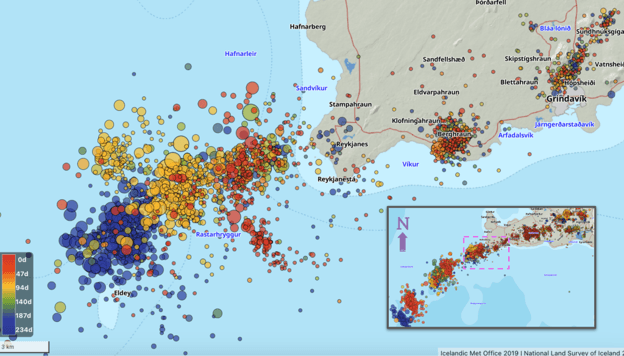
Todos os sismos na região de 01 de janeiro de 2026 a 22 de agosto de 2026. O Enxame Tipo Um é caracterizado pelos sismos a vermelho; o Enxame Tipo Dois pode ser representado pelos sismos a azul e amarelo; e o Enxame Tipo Três é semelhante aos sismos a verde claro (situados sob os dados coloridos a vermelho).
Todos os sismos na região de 01 de janeiro de 2026 a 22 de agosto de 2026. O Enxame Tipo Um é caracterizado pelos sismos a vermelho; o Enxame Tipo Dois pode ser representado pelos sismos a azul e amarelo; e o Enxame Tipo Três é semelhante aos sismos a verde claro (situados sob os dados coloridos a vermelho).
Enxame Tipo Um: Pequenos enxames de sismos que acontecem de forma semiregular e semilinear, principalmente na direção NNE-SSW, em simultâneo com pequenos enxames a oeste de Kleifarvatn, mesmo ao largo de Reykjanesta, e a uma profundidade de alguns quilómetros. Estes têm vindo a acontecer desde que a inflação em Svartsengi começou, algures em 2020-2021. O que isto poderá ser: como a terra está a ser empurrada pelo magma a 4-5 km de profundidade acima de Svartsengi (chamada inflação), isso pode fazer com que a crosta dobre e flexione nas extremidades da curvatura. Estes são por vezes referidos como sismos desencadeados.
Enxame Tipo Dois: Enxames de sismos moderados que acontecem a cada poucos meses, formando uma linha vertical ou geometria em folha na subsuperfície, estendendo-se de níveis profundos a semisuperficiais, perto da ilha de Eldey. Estes têm vindo a acontecer há cerca de dois a três anos, de 2024 em diante. O que isto poderá ser: pode tratar-se de um movimento tectónico normal ao longo da Dorsal de Reykjanes, mas também pode ser movimento de magma no sistema vulcânico Eldey. Os cientistas procurariam outros tipos de dados que corroborassem a hipótese de movimento de magma, mas isso é difícil, uma vez que este sistema vulcânico é inteiramente submarino e, portanto, a recolha de dados é complexa.
Enxame Tipo Três: Enxames de sismos moderados que acontecem a cada poucos meses, formando uma linha vertical ou geometria em folha na subsuperfície, estendendo-se de níveis profundos a semisuperficiais, perto de Reykjanesta. Estes têm vindo a acontecer há cerca de dois anos, de 2024 em diante. O que isto poderá ser: pode tratar-se de um movimento tectónico normal ao longo da Dorsal de Reykjanes e também pode tratar-se de sismos desencadeados, mas poderá ser movimento de magma no sistema vulcânico Reykjanes. Os cientistas procurariam outros tipos de dados que corroborassem a hipótese de movimento de magma e, até ao momento, não se observa inflação nos dados de GPS ou satélite.
Em resumo, muitos dos sismos que observamos são movimentos tectónicos normais da Dorsal Mesoatlântica e/ou sismos desencadeados. No entanto, vemos agora enxames a várias profundidades em redor da ilha de Eldey e mesmo ao largo da ponta da Península de Reykjanes (chamada Reykjanesta) que se assemelham a enxames de movimento de magma observados noutros sistemas vulcânicos em Reykjanes. Sem dados adicionais que corroborem uma hipótese de movimento de magma, não podemos afirmar com confiança que se trata de um sinal de movimento de magma nos sistemas vulcânicos de Reykjanes e/ou Eldey.
Para acrescentar dados sobre qual o sistema vulcânico que poderá estar a registar agitação, Reykjanes ou Eldey (ou ambos), a investigação atual e os registos de erupções passadas apresentam várias ideias.
Teorias predominantes sobre os sistemas vulcânicos geneticamente ligados da Península de Reykjanes
Estas teorias dizem que cada sistema entra em erupção de forma separada e discreta, e que outros sistemas não entrarão em erupção enquanto um estiver ativo; dito isto, isto não impede que um sistema acumule magma enquanto outro está ativo. Ambos os sistemas de Fagradalsfjall e Svartsengi estavam a "carregar" em simultâneo, apenas entraram em erupção em momentos diferentes. Isto pode significar que o sistema vulcânico de Reykjanes poderá estar a começar a acumular magma na subsuperfície para eventualmente entrar em erupção, mas com Svartsengi ainda potencialmente ativo, isso acrescenta dúvidas a uma erupção precoce em Reykjanes.
O sistema vulcânico de Eldey tem entrado em erupção num calendário muito diferente dos sistemas da Península de Reykjanes, incluindo quatro erupções confirmadas e/ou suspeitas nos últimos 150 anos. Assim, o sistema de Eldey move-se ao seu próprio ritmo e não está ligado às possíveis restrições demonstradas pelos sistemas ao longo de Reykjanes. Deste modo, uma erupção ali poderia ocorrer enquanto a atividade continua no sistema vulcânico Svartsengi, ou mesmo no sistema vulcânico Reykjanes.
Então, veremos uma nova erupção em Eldey em breve?
A falha (passando o trocadilho) não está nos nossos vulcões, mas nos nossos dados. Um vulcão entrará em erupção quando decidir; por vezes haverá tendências de erupção que nos ajudam a prever, outras vezes não. Mas, infelizmente, em sistemas submarinos onde a recolha de dados é difícil e fragmentada, e onde a recolha de dados apenas ocorre a níveis modernos e de alta tecnologia há apenas algumas décadas, os cientistas simplesmente não têm dados suficientes para fazer previsões confiáveis em algumas áreas. Infelizmente, esta é muito provavelmente uma situação de "esperar para ver" com ambos os sistemas vulcânicos, à medida que os cientistas recolhem mais dados, constroem mais tendências analógicas e continuam a elaborar hipóteses sobre o que acontecerá a seguir.
Experimente Lava Derretida Real
Os enxames de sismos em redor de Reykjanes e Eldey revelam o quão ativo e complexo pode ser o limite das placas da Islândia — mas a atividade sísmica nem sempre significa que o magma se está a mover ou que uma erupção está iminente. No Lava Show, pode testemunhar em segurança o que acontece quando o magma atinge a superfície e se transforma em lava. Sinta o calor intenso de lava derretida real, oiça-a estalar enquanto arrefece e veja-a solidificar a escassos metros de distância.
Planeie a sua visita:
Experimente o Lava Show Reykjavík – Veja fluir lava derretida real na capital da Islândia.
Experimente o Lava Show Vík – Experimente o único espetáculo de lava ao vivo do mundo na Costa Sul da Islândia.
Oiça o Podcast Lava Academy
Descubra o Podcast Lava Academy onde pode desfrutar de uma conversa aprofundada focada no maravilhoso mundo da geologia, dos vulcões e, claro, da lava!
Este artigo foi escrito pela geóloga Jessica Poteet. Oiça a entrevista com ela no Podcast Lava Academy.