Volcanoes
Eldgjá Eruption: The Largest Volcanic Eruption in Iceland’s History
Discover the Eldgjá eruption, one of the largest lava eruptions in history. Learn how it shaped Iceland’s landscape and climate.
There are no eyewitness accounts of the eruption that tore open southern Iceland in the year 939. No detailed chronicles, no sketches of fire in the sky, only silence where there should have been awe, terror, and memory.
And yet, the evidence is everywhere across the Icelandic landscape and in the scientific data.
Carved into the land itself lies Eldgjá, a vast, jagged canyon stretching across the Icelandic highlands like a wound that never healed. Rivers of hardened basalt snake through valleys towards the waiting oceans, and layers of ash stack high, their origins unmistakable. Beneath glaciers and moss-covered plains, vast swaths of volcanic rock tell a story that no human fully recorded, but the Earth preserved.
This was no ordinary eruption. It was a rupture on a continental scale, a fissure splitting open for kilometers, releasing fire and gas in quantities so immense they dimmed skies far beyond Iceland’s shores. While written history offers only fragments and echoes, geology speaks with certainty: something extraordinary happened here.
To understand Eldgjá is to piece together a story told not by direct witnesses, but by second hand scholars, landscapes, ice cores, tree rings, and the chemistry of ancient air. It is a reminder that even when human memory fails, the planet keeps its own record.
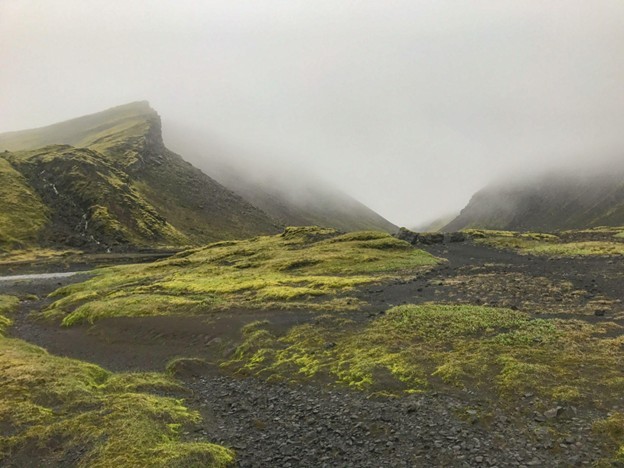
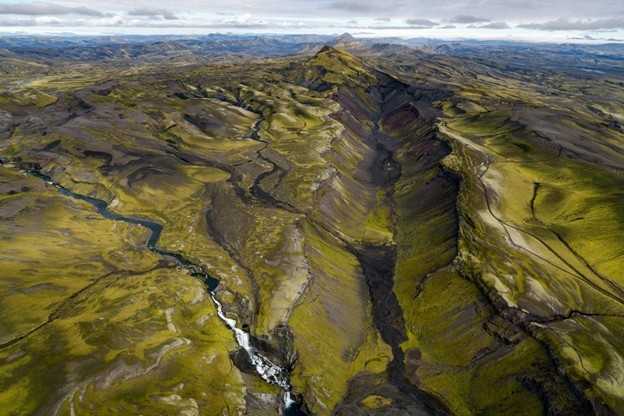
The fissure created by the Eldgjá eruption in 939 cuts a scar across the Highlands landscape. Beautiful blacks and reds of lava rocks peek through the green moss of the hills. Ófærufoss, the main waterfall in the area, cascades into the canyons after its feeder river snakes past craters.
Quick Facts about the Eldgjá Eruption
Date: most likely 939–940 CE, but maybe 934
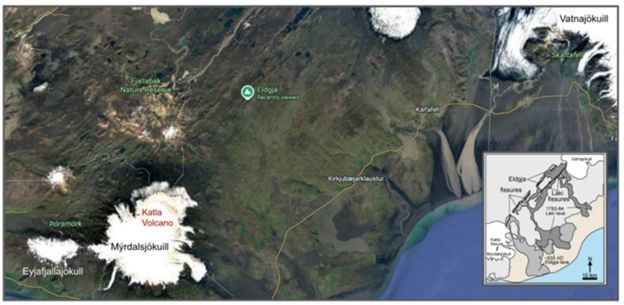
Location: Southern Iceland, a canyon northeast of Mýrdalsjökull,
Volcanic System: part of the Katla volcanic region
Eruption Type: Fissure eruption (with associated eruptions of the central volcano); many polygenetic episodes comprising 16 explosive eruptions and two main, large lava fields fed by 3-4 fissure sections
Fissure length: 70-75 km total, both subglacial and subaerial components (±45 miles), erupting discontinuously over several months to years
Lava & Tephra Area: 780-850 km2 (300-325 sq miles) of lava; 2600 km2 was covered under more than 10 cm of tephra, and 600 km2 under more than 1 meter
Lava & Tephra Volume: lava volume ~20 km3 (for comparison, the 2021 Fagradalsfjall eruption was only 0.15 km3); tephra volume ~4-6 km3
Longest Lava Flow: estimates say ~50-60 km
Lava Type: primarily alkali basalt with minor percentage of tholeiitic basalts in the northern fissure sections
Gas Emissions: Enormous sulfur dioxide release, 220-230M tons of sulfur dioxide
Significance: Largest effusive lava eruption on Earth in the past ~1,000 years; largest volcanic atmospheric pollution event of the last several millennia
Eldgjá: The mystery of Iceland´s largest volcanic eruption since the island was settled
Eldgjá is a volcanic event that amazes scientists and puzzles historians. In a canyon northeast of the Katla volcano lies a long line of abandoned craters, layers of lava and ash, and exceptional geographic evidence of a long-lived eruption. For tens of kilometers, Iceland’s longest fissure scars the landscape and slices through the Highlands. Something happened here.
And yet, even though 30,000 people already had settled on the island, there are no direct accounts of the world´s largest volcanic eruption terrorizing the land and people. Perhaps philosophers should have asked instead, “if a volcano erupts on an island, and nobody notices, did it make a sound?”
But through extensive research and deduction, scientists and historians have pieced together a story that tells the tale of this unimaginable event.
What are the main clues we have of the Eldgjá eruption?
Direct geologic evidence: a massively long canyon with now moss-covered craters, rift-related faults, eruption-related volcanic features, and over a meter (3 feet) of ash and lava.
Direct science evidence: ash layers in neighboring regions; spikes in acid, salt, and glass shards in layers of ice in glaciers throughout North America; increase in carbon and climate cooling signals in the tree rings associated with this time frame.
Indirect weather evidence: the winter of 939-940 was recorded as especially harsh, and evidence for temperature drops and flooding across northern and central Europe, northern North America, and Central Asia exists; records of drought across the Nile during the following seasons, which is strongly linked to volcanic pollutants affecting local monsoons.
Indirect witness statements: there are several mentions in ancient texts about the sun being “reduced” or “halved,” as in color and brightness changes, in the sky during the summer of 939, across the U.K., France, Germany, Spain, and Italy.
Direct witness stories(?): in the books written about the settlement of Iceland, some several hundred years after the fact, it is mentioned that two farmers had to abandon their nearby farms because of fires in the mountains.
The fissure created by the Eldgjá eruption in 939 cuts a scar across the Highlands landscape. Beautiful blacks and reds of lava rocks peek through the green moss of the hills. Ófærufoss, the main waterfall in the area, cascades into the canyons after its feeder river snakes past craters.
Further Cultural Evidence for the Eldgjá Eruption
There is strong speculation that Norse creation myths and/or the story of Ragnarök were influenced by the events potentially witnessed at Eldgjá and the surrounding areas. The famous Vóluspá, an Icelandic poem that recounts the prophecy of the earth´s creation and destruction, is postulated as being formed in oral storytelling tradition in the 10th century (i.e. 900s CE) and then finally written down by local scholars in the 13th century.
For those pop culture obsessed, parts of the Vóluspá have influenced Tolkien´s work in The Lord of the Rings, and stanzas of the poem have shown up in the T.V. show Vikings and the video game Assassin´s Creed.
The Greater Geologic Picture of Eldgjá in Iceland
There is evidence across the Icelandic landscape, in the geologic rock record and geographic footprint, that many volcanic events were happening throughout the island during this timeframe. This aligns with the understanding that rift events, from the plate boundary that splits the island, can sometimes happen in pulses, creating periods of linked, increased activity. Magma injected from deep in the earth´s crust is proposed to happen in waves or bursts, as opposed to slow, steady seeping. Thus, we see periods of increased eruptions and rifting (ground growth).
The Eldgjá eruption was especially large and dangerous at 16 central volcano-located explosive eruptions happened simultaneously at Katla as the Eldgjá fissure eruptions. This caused towering columns of ash and ejecta to push into the upper atmosphere. Evidence for this is seen in ash layers in Greenland, which is against the prevailing surface wind direction! Most research of modern eruption in Iceland indicates that it is very rare for a volcanic system to produce fissure eruptions and central volcano eruptions at the same time.
Final Thoughts on the famous Eldgjá Eruption
The 939 Eldgjá eruption stands as one of the most powerful volcanic events in recorded history. It reshaped Iceland’s landscape, altered climate across continents, and may even have influenced human storytelling. Today, it serves as both a scientific benchmark and a reminder of nature’s immense force.
By studying Eldgjá, and experiencing volcanic processes firsthand through places like Lava Show, we gain not only knowledge, but perspective: the Earth beneath us is alive, dynamic, and capable of change on a truly epic scale.
Frequently Asked Questions About Eldgjá
Experience Real Molten Lava
The Eldgjá eruption was one of the largest lava eruptions in recorded history, creating a vast canyon and dramatically reshaping Iceland’s landscape. While eruptions of this scale are exceptionally rare, Lava Show gives you the chance to safely experience the awe-inspiring sight of real molten lava flowing just metres away. Feel the intense heat, hear the lava crackle and gain a deeper appreciation of the powerful volcanic forces that have shaped Iceland for centuries.
Plan your visit:
Experience Lava Show Reykjavík – Watch real molten lava flow in Iceland’s capital.
Experience Lava Show Vík – Experience the world’s only live lava show on Iceland’s South Coast.
Read More about the Eldgjá eruption
Listen to the Lava Academy Podcast
Discover the Lava Academy Podcast where you get in-depth conversation foscusing on the wonderful world of geology, volcanos and of course lava!
Podcast Episode on the Eldgjá eruption
Listen to an episode on the Eldgjá in the Lava Academy Podcast featuring an interview with volcanologist Glen L’Estrange who has thoroughly researched the Eldgjá eruption.
This article is written by geologist Jessica Poteet. Listen to the interview with her on the Lava Academy Podcast.