Volcans
Volcan Torfajökull : le volcan rhyolitique le plus coloré et unique d’Islande
Découvrez le Torfajökull, le volcan de rhyolite flamboyant de l'Islande, réputé pour ses paysages colorés et sa géologie volcanique unique.
Dans un pays caractérisé par un basalte noir saisissant, des fontaines de feu en éruption et des champs de lave coulants, le Torfajökull se distingue véritablement. Ce volcan central, niché dans les Hautes Terres reculées du centre-sud, est le système rhyolitique le plus vaste et le plus spectaculaire d'Islande. C'est un endroit où le magma évolue, où les couleurs explosent à travers le paysage, et où les éruptions se comportent de manière bien différente des fameuses éruptions de fissures de ces dernières années.
C'est aussi un volcan que l'on décrit souvent comme étant « en retard ».
Ce mot a tendance à faire sourcilier... et à faire grimper la tension. Savoir qu'un volcan réputé pour ses grandes éruptions explosives est en retard peut être source d'anxiété. Mais en géologie, « en retard » signifie rarement ce que l'on s'imagine.
Quelques faits rapides sur le Torfajökull
Dates des principales éruptions : Dernière éruption connue en 1477 ; plus grande éruption moderne en ±877
Emplacement : Centre-sud de l'Islande (Réserve naturelle de Fjallabak, près de Landmannalaugar)
Type de système volcanique : Volcan central avec caldeira (~12 × 18 km) ; fissures locales connues
Type d'explosion : Éruption plinienne de courte durée avec une colonne de tephra de ±20 km à la verticale
Type d'éruption et de lave : Silicique (rhyolitique), souvent explosive, avec des fissures de lave à chimie mixte
Longueur de la fissure : Fissures généralement courtes (groupes de 1 à 2,5 km sur une zone de 40 km)
Superficie du système : La superficie totale des matériaux extrusifs exposés est de 450 km2 ; la zone géothermique s'étend sur 150 km2
Plus longue coulée de lave : Limitée ; la rhyolite a tendance à former des coulées courtes et épaisses, et les fissures plus basaltiques ont une longueur de coulée maximale de 2 km
Émissions de gaz : Peu de preuves historiques à ce sujet ; il est possible qu'il y ait eu des émissions locales à base de fluor et de soufre
Importance : Le plus grand système de rhyolite et le plus grand système géothermique d'Islande ; essentiel pour comprendre la formation de la croûte continentale dans un environnement océanique, et l'un des rares endroits où de la rhyolite abondante entre en éruption sur la croûte océanique. A également produit une couche de cendres appelée la couche de la colonisation (« Settlement Layer »).
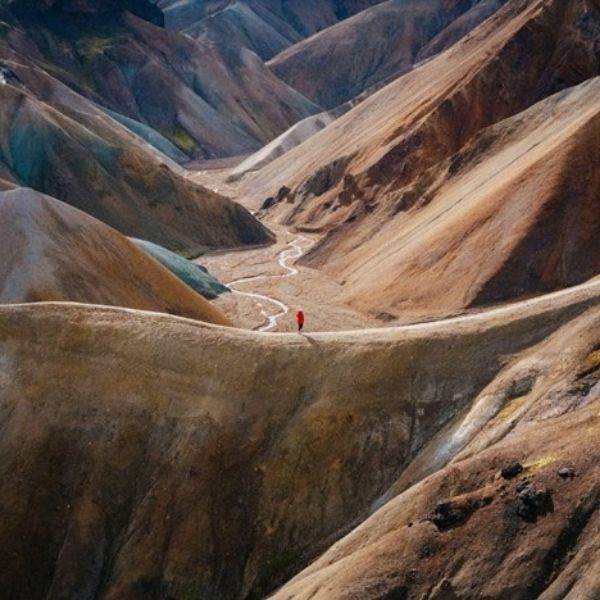
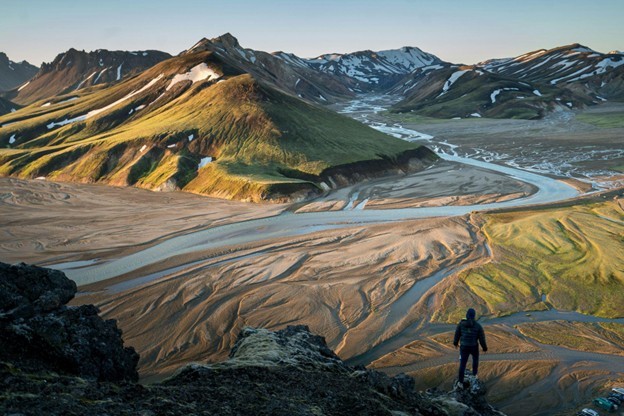
Un randonneur se tient au milieu des montagnes de rhyolite du système volcanique de Torfajökull et contemple la célèbre colline verte de Grænihryggur. Cette couleur verte éclatante est causée par une altération géothermique, où des minéraux tels que la chlorite, l'épidote et la céladonite se sont formés au sein de la roche.
Qu'est-ce qui rend le Torfajökull si spécial ?
Bien que le Torfajökull ne possède pas de laves rares si on les compare à d'autres laves en éruption à travers le monde, ce qui le rend exceptionnel, c'est la rareté de ce type de lave sur les systèmes de croûte océanique et récente.
En Islande, la grande majorité des éruptions produisent du basalte, une lave fluide, sombre et directement issue du manteau le long des zones de rift actives. Le Torfajökull brise cependant ce schéma. Il se situe à la lisière des zones de rift actives d'Islande, là où l'étirement tectonique, l'apport de magma et les processus crustaux interagissent de manière plus complexe. Au lieu de simplement livrer du basalte frais directement à la surface, ce système volcanique permet au magma de stagner, d'évoluer et de se différencier chimiquement au fil du temps.
Le résultat est un grand volcan central dominé par la rhyolite, un magma visqueux et riche en silice que l'on associe plus souvent aux milieux continentaux qu'à un environnement de dorsale médio-océanique. Cela suffit à rendre le Torfajökull inhabituel. Mais sa géographie ajoute une autre dimension d'unicité : un vaste système de caldeira, façonné par des éruptions passées et des effondrements qui s'étendent sur des centaines de milliers d'années (voire plus !), entouré de champs géothermiques et de montagnes rhyolitiques qui témoignent de cycles répétés de réchauffement, d'altération et d'éruption.
Cette combinaison de facteurs crée quelque chose que l'on voit rarement en Islande. Plutôt que de vastes plaines de lave s'étendant sur des kilomètres, comme les champs de lave que vous apercevez en conduisant de l'aéroport de Keflavík vers Reykjavík, le Torfajökull produit des coulées de lave, des dômes et des dépôts explosifs plus courts et plus épais. Au fil du temps, cela a façonné un relief saisissant de montagnes multicolores, de coulées d'obsidienne, de couches de tephra et de terre fumante, dont l'expression la plus célèbre se trouve dans des zones comme Landmannalaugar.
Ce qui distingue vraiment le Torfajökull, c'est donc l'histoire que raconte cette lave et le laboratoire que deviennent ces montagnes pour la formation d'une croûte unique. C'est un endroit où les processus volcaniques habituellement simples de l'Islande deviennent plus complexes : là où le basalte se transforme en rhyolite, là où la croûte océanique commence à se comporter davantage comme une croûte continentale, et là où le paysage reflète cette transformation de manière éclatante et indéniable.
Cette région est régulièrement classée parmi les meilleures destinations de randonnée au monde. Mais ce volcan n'est-il pas censé entrer en éruption d'un moment à l'autre ? Devez-vous vous inquiéter ?
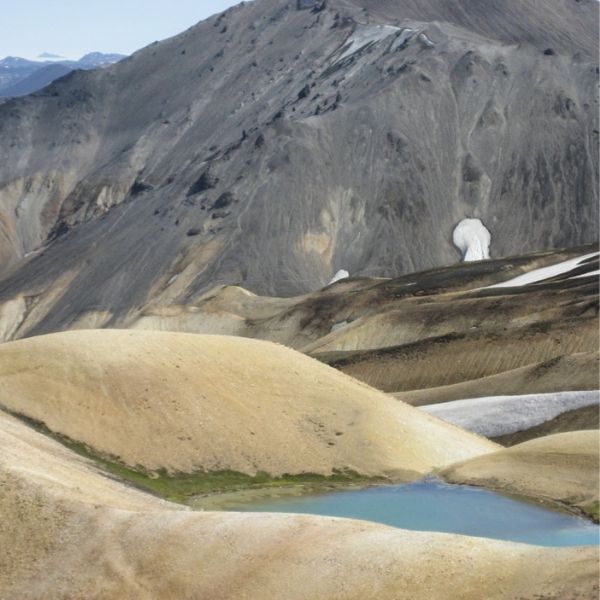
Vue de Landmannalaugar, l'une des plus belles régions de randonnée au monde, à l'extrémité nord du système volcanique de Torfajökull. Des traces d'éruptions rhyolitiques vieilles de plusieurs siècles et des altérations géothermiques colorent le paysage.
Le volcan Torfajökull est-il vraiment « en retard » pour sa prochaine éruption ?
De nombreux volcans du sud et de l'est de l'Islande ont été qualifiés d'« en retard ». Heureusement, il s'agit généralement d'une statistique inventée de toutes pièces pour susciter de l'engagement sur les réseaux sociaux ou faire de la publicité pour un documentaire. Alors pourquoi le Torfajökull, qui n'est pas entré en éruption depuis 550 ans, n'est-il PAS en retard ? Penchons-nous sur les raisons scientifiques pour lesquelles les volcans ne peuvent pas être en retard :
Les volcans ne fonctionnent pas avec un minuteur. Certes, certains systèmes volcaniques semblent assez réguliers (on pense notamment aux systèmes volcaniques de Reykjanes), mais ce ne sont pas pour autant des horloges avec des horaires fixes. Les volcans ne fonctionnent pas ainsi. Il y a très peu de choses en géologie qui soient à ce point prévisibles. Même pour Reykjanes, il semble y avoir une « marge de manœuvre » de plusieurs centaines d'années entre les débuts de cycles prévus.
Les intervalles d'éruption ne sont pas basés sur un compte à rebours fixe. La plupart des volcans sont âgés de dizaines de milliers ou de millions d'années, et la majorité des enregistrements historiques modernes sur les éruptions ne couvrent qu'une infime partie de la vie d'un volcan. Difficile de dégager une tendance prédictive avec si peu de données !
Nos données ne sont pas parfaites. La plupart des données concernant les volcans islandais ont été brouillées par (a) une glaciation intense qui a érodé les traces des éruptions passées, ou (b) une altération hydrothermale qui a modifié les roches plus anciennes au fil du temps. Et sans relevés historiques modernes pour associer les éruptions à des dates précises, la marge d'erreur de prédiction pour la plupart des éruptions anciennes s'étend de plusieurs centaines à des milliers d'années.
Nous utilisons une surveillance moderne pour mieux comprendre. La plupart des volcans d'Islande font l'objet d'une surveillance active et approfondie grâce à des outils numériques modernes. Mais cela n'a pas toujours été le cas. Cela signifie que toute prédiction concernant les volcans a été formulée à partir de preuves indirectes ou d'outils moins qualitatifs. Heureusement, cela signifie aussi que les scientifiques et les experts en risques naturels surveillent de très près les volcans islandais à chaque instant, et qu'ils tirent la sonnette d'alarme si nécessaire pour informer le public en temps réel.
Foire aux questions sur le système volcanique de Torfajökull
Le Torfajökull est-il dangereux en ce moment ?
Aucun signe ne suggère une éruption imminente. Il est sous surveillance, mais reste calme pour l'instant.
Pourrait-il entrer en éruption ce siècle-ci ?
Oui, c'est possible. Mais c'est une tout autre chose que de dire qu'il entrera en éruption bientôt !
Une éruption ressemblerait-elle à celle de Reykjanes ?
Probablement pas. Attendez-vous plutôt à un comportement plus explosif, des coulées plus courtes et potentiellement des chutes de cendres.
Pourquoi considère-t-on le système de Svartsengi comme « en retard » et pas un système comme le Torfajökull ?
Les éruptions actuelles au nord de Grindavík dans le système de Svartsengi présentent de nombreux signes d'activité, tels que le gonflement du sol, une sismicité fréquente, le remplissage de magma et des éruptions associées au cours des deux dernières années ; rien de tel ne se produit actuellement au Torfajökull, même s'il n'est pas entré en éruption depuis 1477.
Le terme « en retard » est-il utile ?
Pas vraiment. Il est accrocheur, mais scientifiquement trompeur.
Pourquoi la région est-elle si colorée ?
La rhyolite combinée à l'altération géothermique colore les minéraux dans des tons de rouge, jaune, vert et bleu. Même si le système volcanique n'est pas actif actuellement, le système géothermique l'est, et il transforme les roches de la région à l'heure où nous parlons !
Le mot de la fin sur le volcan Torfajökull
Le Torfajökull est là pour nous rappeler que les volcans d'Islande ne suivent pas de scénario préétabli.
Son magma rhyolitique raconte une histoire plus lente et plus complexe que les éruptions basaltiques ultra-rapides qui font la une des journaux aujourd'hui. Et son statut de soi-disant volcan « en retard » souligne une vérité fondamentale de la géologie : le temps seul ne déclenche pas les éruptions, ce sont les processus géologiques qui s'en chargent.
Au Lava Show, la plupart des visiteurs découvrent de la lave basaltique en fusion, du même type que celle qui jaillit à Svartsengi et à travers toute la péninsule de Reykjanes.
Le Torfajökull, lui, raconte l'autre moitié de l'histoire. Ses roches de rhyolite répondent aux questions :
Pourquoi certaines éruptions explosent au lieu de couler ;
Pourquoi cette lave se déplace à peine ;
Que se passe-t-il lorsque le magma évolue au fil du temps ?
Heureusement pour nous, le Lava Show ne propose aucune explosion volcanique, seulement des explosions de découvertes et d'informations passionnantes !
En savoir plus sur le volcan Torfajökull
Vivez l'expérience d'une véritable lave en fusion
Le Torfajökull est l'un des systèmes volcaniques les plus colorés et les plus fascinants d'Islande sur le plan géologique, façonné par des milliers d'années d'activité volcanique. Alors que ses montagnes de rhyolite et ses paysages géothermiques révèlent les vestiges des éruptions passées, le Lava Show vous permet d'observer le processus volcanique lui-même en action. Regardez de la véritable lave en fusion couler à quelques mètres de vous dans un environnement sûr et contrôlé, et ressentez la chaleur, le bruit et le mouvement de l'une des forces les plus puissantes de la nature.
Préparez votre visite :
Découvrez le Lava Show de Reykjavík – Admirez de la vraie lave en fusion couler en plein cœur de la capitale islandaise.
Découvrez le Lava Show de Vík – Vivez l'expérience de l'unique spectacle de lave en direct au monde sur la côte sud de l'Islande.
Écoutez le podcast de la Lava Academy
Découvrez le podcast de la Lava Academy (en anglais) où vous pourrez suivre des discussions approfondies sur le monde merveilleux de la géologie, des volcans et, bien sûr, de la lave !
Cet article a été rédigé par la géologue Jessica Poteet. Écoutez son interview sur le podcast de la Lava Academy.