Podcast
Le Podcast de la Lava Academy : À la découverte des volcans de l'Antarctique
Quand on pense à l'Antarctique, on s'imagine généralement des étendues de glace infinies, un froid extrême et peut-être quelques manchots. Les volcans ne sont sans doute pas la première chose qui nous vient à l'esprit !
Pourtant, sous l'immense calotte glaciaire du continent se cache l'une des régions volcaniques les plus remarquables de notre planète.
Dans cet épisode du Lava Academy Podcast, l'animateur Iain MacKinnon et sa co-animatrice Ragnhildur Ágústsdóttir accueillent Ann Sophie Bader, membre de la super équipe du Lava Show de Vík.
Ann Sophie partage son année entre deux paysages absolument extraordinaires. Elle travaille au Lava Show en Islande et, pendant l'hiver de l'hémisphère nord, met le cap au sud pour travailler dans un camp touristique reculé en Antarctique.
Sa fascination pour l'Antarctique est née alors qu'elle travaillait comme guide de glacier en Islande. Après plusieurs années à chercher un moyen de se rendre sur ce continent blanc, elle a décroché son tout premier job là-bas : nettoyer les installations, monter les tentes et faire tout ce qui était nécessaire. Aujourd'hui, elle y travaille comme agente de liaison pour les visiteurs, accompagnant des voyageurs aventureux, des alpinistes et des athlètes de l'extrême.
Dans cet épisode, Ann Sophie nous emmène sous la glace pour explorer un monde volcanique qui reste en grande partie caché.
Dans cet épisode consacré aux volcans et aux éruptions en Antarctique
Découvrez pourquoi l'Antarctique est bien plus actif sur le plan volcanique qu'il n'y paraît à première vue. Ann Sophie nous explique :
Pourquoi tant de volcans antarctiques sont enfouis sous des kilomètres de glace
Comment des chercheurs ont identifié 91 structures volcaniques jusqu'alors inconnues en Antarctique occidental
Pourquoi le système de rift de l'Antarctique occidental est si important d'un point de vue géologique
Comment l'île de la Déception a été créée par une immense éruption explosive
Pourquoi le mont Erebus abrite l'un des rares lacs de lave persistants de la Terre
Ce qui rend la lave phonolitique de l'Erebus si inhabituelle
Comment le volcan libère de microscopiques particules d'or
Pourquoi l'Erebus produit de spectaculaires bombes volcaniques
Comment les mesures radar, gravitationnelles et magnétiques révèlent ce qui se cache sous la glace
Comment la chaleur volcanique influence les glaciers de l'Antarctique
Pourquoi le changement climatique — et non l'activité volcanique — est la cause principale de la perte de glace en Antarctique
Regardez l'épisode du podcast
Découvrez l'intégralité de notre conversation avec Ann Sophie et plongez au cœur des forces volcaniques cachées sous le continent le plus froid du monde.
L'Antarctique est-il volcanique ?
L'Antarctique n'est pas uniforme sur le plan volcanique.
La majeure partie de l'activité volcanique connue du continent se concentre dans l'Antarctique occidental, en particulier autour du système de rift de l'Antarctique occidental. Cette immense structure géologique est une zone où la croûte continentale s'est étirée et amincie, permettant au magma de remonter plus facilement des profondeurs.
C'est un contexte différent de celui de l'Islande, où les plaques tectoniques nord-américaine et eurasiatique s'écartent le long de la dorsale médio-atlantique. Le système de rift de l'Antarctique occidental, quant à lui, se trouve directement à l'intérieur du continent antarctique.
Une étude majeure a permis d'identifier 138 structures volcaniques potentielles sous la calotte glaciaire de l'Antarctique occidental. Chose incroyable : 91 d'entre elles n'avaient jamais été repérées auparavant !
Beaucoup de ces volcans sont entièrement recouverts de glace. Au lieu d'observer les célèbres montagnes en forme de cône que l'on associe aux volcans, les scientifiques doivent traquer leurs silhouettes sous une surface gelée qui peut dépasser les quatre kilomètres d'épaisseur.
Et les chercheurs pensent qu'il reste encore de nombreuses structures volcaniques qui n'attendent qu'à être découvertes !
Un continent 136 fois plus grand que l'Islande
La taille de l'Antarctique rend la recherche volcanique particulièrement difficile.
Le continent est environ 136 fois plus grand que l'Islande. Atteindre un volcan potentiel peut impliquer de parcourir d'immenses distances par un froid extrême, souvent à travers des zones parsemées de dangereuses crevasses cachées sous la neige.
Transporter des scientifiques et du matériel dans ces régions reculées s'avère également extrêmement coûteux.
Déjà, en Islande, surveiller un volcan recouvert d'un glacier est un vrai défi. En Antarctique, les chercheurs doivent mener leurs investigations sur un continent infiniment plus vaste, sous une calotte glaciaire qui atteint par endroits plusieurs kilomètres d'épaisseur.
Il n'existe toujours pas d'image tridimensionnelle complète de tout ce qui se cache sous la glace antarctique. Cela laisse de nombreuses questions sans réponse sur l'histoire volcanique du continent et son activité actuelle.
Comment les scientifiques trouvent-ils des volcans sous la glace ?
Les chercheurs utilisent plusieurs méthodes ingénieuses pour explorer les paysages cachés de l'Antarctique.
Des avions équipés de systèmes radar survolent la calotte glaciaire, permettant aux scientifiques de cartographier la forme du socle rocheux situé en dessous. Les observations par satellite révèlent également les grandes structures et les variations à la surface de la glace.
Les mesures de gravité apportent un autre indice précieux. La roche volcanique est généralement plus dense que de nombreux sédiments environnants, ce qui crée de légères variations dans le champ gravitationnel local.
Les scientifiques utilisent aussi des instruments magnétiques très sensibles, car les roches volcaniques contiennent souvent des minéraux riches en fer qui influencent les relevés magnétiques.
En combinant le radar, l'imagerie satellite, les études gravitationnelles et les mesures magnétiques, les chercheurs parviennent à dresser le portrait d'un paysage qu'ils ne peuvent pas voir de leurs propres yeux.
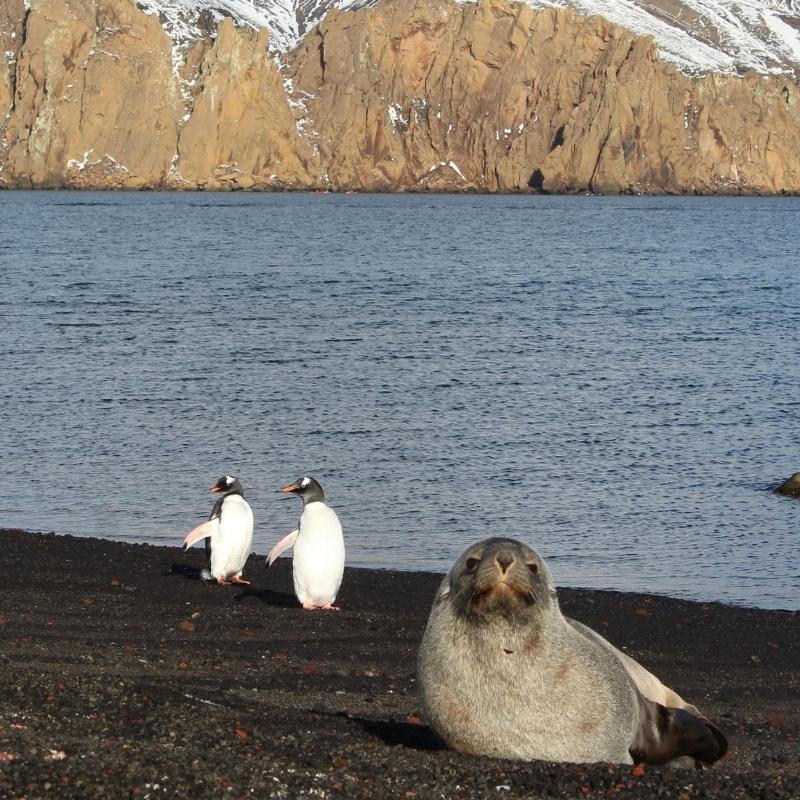
Un phoque et deux manchots papous à Whalers Bay, au cœur de la caldeira inondée de l'île de la Déception — un volcan actif situé près de la péninsule Antarctique.
L'île de la Déception : un volcan déguisé en île
L'un des systèmes volcaniques explorés dans cet épisode est l'île de la Déception, située près de la péninsule Antarctique.
De l'extérieur, elle ressemble à une île ordinaire en forme de fer à cheval. Cependant, un passage étroit permet de traverser sa paroi extérieure pour pénétrer dans une caldeira volcanique inondée, formant un immense port naturel.
Cette entrée cachée est à l'origine du nom de l'île. Les premiers explorateurs qui passaient au large pouvaient facilement s'y tromper et croire qu'ils observaient une île pleine, plutôt que le bord d'un volcan.
L'île de la Déception est toujours active. Elle a connu plusieurs éruptions au cours du XXe siècle, la dernière confirmée remontant à 1970.
Elle est également célèbre pour son activité géothermique, notamment dans les zones où la chaleur volcanique réchauffe le sol et les eaux côtières.
L'immense éruption qui a donné naissance à l'île de la Déception
La caldeira inondée a été créée par l'une des plus grandes éruptions antarctiques confirmées de l'Holocène.
Les recherches situent aujourd'hui cette éruption majeure à environ 4 000 ans. Les scientifiques estiment qu'elle a libéré entre 30 et 60 kilomètres cubes de magma.
À titre de comparaison, l'éruption de l'Eyjafjallajökull en 2010 en Islande n'a produit qu'une toute petite fraction de kilomètre cube de matière volcanique !
L'éruption de l'île de la Déception a été si puissante qu'elle a provoqué l'effondrement de la structure centrale du volcan, créant cette grande caldeira que l'eau de mer a ensuite envahie. Des traces de cette éruption ont été retrouvées dans les glaces et les sédiments de l'Antarctique, à des milliers de kilomètres du volcan.
Malgré l'ampleur de cet événement ancien, les éruptions plus récentes de l'île de la Déception ont été considérablement plus modestes.
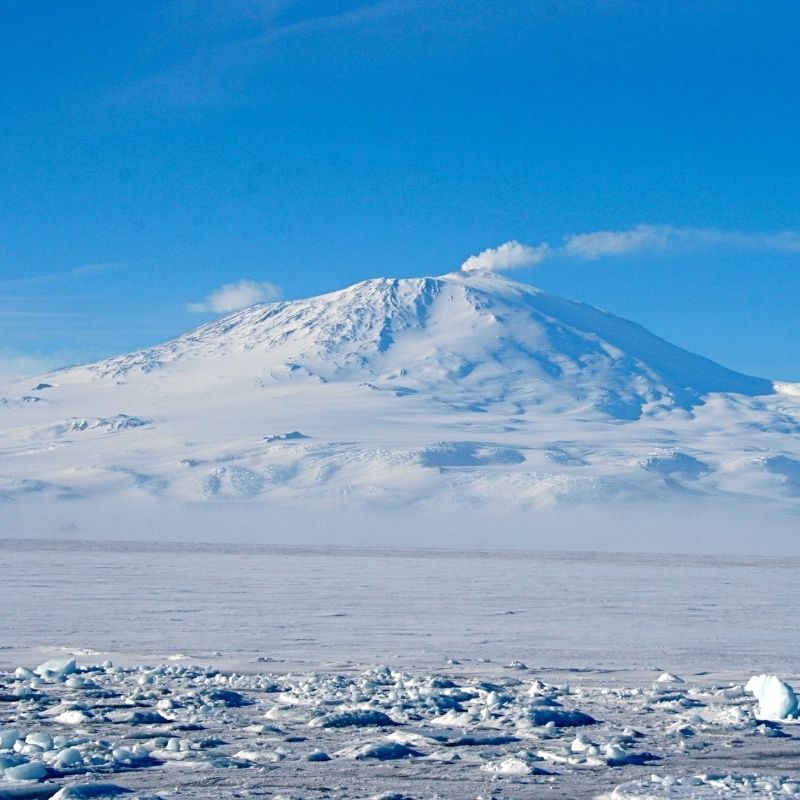
Le mont Erebus culmine à 3 794 mètres au-dessus de l'île de Ross, en Antarctique. Sous son sommet enneigé se cache l'un des rares lacs de lave persistants de la planète, actif depuis des décennies.
Le mont Erebus : le volcan au lac de lave de l'Antarctique
Cet épisode s'intéresse également au volcan actif le plus célèbre de l'Antarctique : le mont Erebus.
S'élevant à 3 794 mètres d'altitude sur l'île de Ross, l'Erebus est considéré comme le volcan actif le plus méridional de la planète. Situé non loin de la station McMurdo et de la base Scott (Nouvelle-Zélande), il offre aux chercheurs de la région un voisin volcanique des plus impressionnants !
Contrairement à la plupart des structures volcaniques cachées de l'Antarctique, l'Erebus ressemble exactement au volcan que l'on dessine quand on est enfant : un immense cône indéniable qui domine le paysage environnant.
Mais sa caractéristique la plus fascinante se trouve au fond de son cratère sommital.
Le mont Erebus abrite l'un des rares lacs de lave persistants au monde.
Qu'est-ce qu'un lac de lave persistant ?
Un lac de lave est une masse de roche en fusion exposée à l'air libre au sein d'un cratère ou d'une cheminée volcanique.
Des lacs de lave temporaires peuvent se former lors de certaines éruptions, comme on le voit parfois en Islande. Cependant, la plupart finissent par se vider ou par se refroidir et se solidifier.
Le lac de lave du mont Erebus est bien différent. Il persiste depuis des décennies et fait l'objet d'observations continues depuis au moins 1972.
Les scientifiques pensent que ce lac est maintenu par un système de circulation continue de magma et de gaz volcaniques. Le magma chaud remonte vers la surface tandis que le magma plus froid et plus dense replonge dans le système volcanique. Cela crée un cycle similaire à la convection dans une casserole d'eau chaude.
Des bulles de gaz remontent également à travers le lac et éclatent à la surface. Cette libération régulière de gaz permet d'éviter une trop forte accumulation de pression, même si l'Erebus peut tout de même produire de soudaines explosions.
La phonolite : l'insolite lave du mont Erebus
La majeure partie de la lave produite en Islande est du basalte. La lave basaltique est extrêmement chaude et relativement fluide, ce qui lui permet de former de véritables rivières de roche en fusion.
Le mont Erebus, lui, renferme un type de magma beaucoup plus rare appelé phonolite.
La phonolite est riche en éléments alcalins comme le sodium et le potassium. Elle est généralement plus visqueuse que le basalte, ce qui rend la survie d'un lac de lave ouvert et en circulation continue particulièrement exceptionnelle !
Le nom « phonolite » signifie littéralement « pierre sonore ». Certains morceaux de phonolite peuvent produire un son cristallin lorsqu'on les frappe, presque comme une cloche.
La phonolite de l'Erebus contient également de grands cristaux de feldspath. Ces cristaux peuvent se retrouver piégés dans les projections du volcan, offrant aux scientifiques des indices précieux sur ce qui se trame dans sa chambre magmatique.
Des bombes volcaniques issues du lac de lave
Le mont Erebus produit régulièrement des bombes volcaniques.
Une bombe volcanique se forme lorsqu'une explosion projette de la roche en fusion ou partiellement solidifiée dans les airs. La matière commence à refroidir et à prendre sa forme finale pendant son vol avant de retomber sur les flancs du volcan.
À l'Erebus, de grosses bulles de gaz remontent à travers le lac de lave et éclatent à la surface. Ces explosions peuvent projeter des fragments de lave à des centaines de mètres de hauteur.
Même si le lac de lave libère fréquemment sa pression, l'Erebus reste un volcan actif. Ses explosions soudaines nous rappellent que même une activité volcanique relativement stable peut s'avérer imprévisible.
Le volcan qui crache de l'or
Le mont Erebus possède une autre caractéristique surprenante : il libère de microscopiques particules d'or !
L'or est transporté hors du volcan par les gaz volcaniques. Lorsque ces gaz chauds entrent en contact avec l'atmosphère glaciale de l'Antarctique, de minuscules particules se condensent et se dispersent dans l'air.
De l'or provenant de l'Erebus a été détecté très loin du volcan. Cependant, n'espérez pas l'ouverture d'une mine d'or en Antarctique ! Ces particules sont microscopiques, extrêmement dispersées et présentes dans des concentrations infimes.
Ce phénomène est avant tout fascinant sur le plan scientifique plutôt qu'intéressant commercialement. Il démontre à quel point le magma complexe de l'Erebus est capable de concentrer et de transporter des éléments insolites.
Un volcan pourrait-il entrer en éruption sans percer la glace ?
Avec autant de volcans antarctiques enfouis sous d'épaisses couches de glace, il est tout à fait possible qu'une éruption n'atteigne jamais la surface.
Le magma pourrait faire fondre une partie de la glace environnante et créer de grandes poches d'eau sous la calotte sans produire de panache d'éruption visible. Cette activité générerait tout de même des signes précurseurs, comme des séismes, des variations de chaleur ou des mouvements dans la glace.
Mais détecter ces signes est un véritable défi. Les sismographes fonctionnent de manière optimale lorsqu'ils sont installés sur un socle rocheux solide, qui peut se trouver sous des kilomètres de glace. De plus, la taille gigantesque de l'Antarctique empêche de surveiller chaque zone volcanique potentielle d'aussi près que les scientifiques le font pour les régions actives d'Islande.
La chaleur volcanique fait-elle fondre les glaces de l'Antarctique ?
La chaleur géothermique fait effectivement fondre la glace par le bas dans certaines parties de l'Antarctique occidental.
Cela peut influencer la stabilité et le déplacement de certains glaciers. L'eau présente sous un glacier peut réduire la friction entre la glace et la roche, permettant au glacier de glisser plus rapidement vers l'océan.
Cependant, Ann Sophie insiste bien sur une distinction essentielle dans cet épisode : la chaleur volcanique et géothermique n'est pas la cause principale de la perte de glace actuelle en Antarctique.
Les plus grandes menaces restent le réchauffement de l'atmosphère et, en particulier en Antarctique occidental, l'arrivée d'eaux océaniques plus chaudes sous les plateformes de glace flottante et à la base des glaciers.
On peut citer l'exemple du glacier Thwaites, parfois surnommé de façon spectaculaire le « glacier de l'Apocalypse ». Son recul est crucial car il sert de rempart pour retenir une partie bien plus vaste de la calotte glaciaire de l'Antarctique occidental.
Les scientifiques estiment que la perte totale du glacier Thwaites à elle seule ferait monter le niveau mondial de la mer d'environ 65 centimètres. La disparition complète de la calotte de l'Antarctique occidental aurait des conséquences bien plus grandes encore, même si de tels changements s'étendraient sur une période très longue et restent au cœur de recherches intensives.
La fonte des glaces pourrait-elle influencer l'activité volcanique future ?
La glace exerce une pression colossale sur la croûte terrestre située en dessous.
Lorsqu'une calotte glaciaire s'amincit, cette pression diminue. Dans certaines régions volcaniques, ce soulagement de la croûte terrestre peut stimuler la production de magma ou faciliter sa remontée vers la surface.
Cette relation a été étudiée de près en Islande et dans d'autres régions volcaniques autrefois glaciaires. Néanmoins, les systèmes volcaniques de l'Antarctique restent encore mystérieux, et les scientifiques ne peuvent pas encore affirmer avec certitude comment la fonte future des glaces influencera l'activité volcanique sous le continent.
C'est une raison de plus pour laquelle la cartographie et la surveillance des volcans cachés de l'Antarctique sont si importantes !
Faut-il s'inquiéter des volcans de l'Antarctique ?
Il n'y a actuellement aucune preuve suggérant que l'Antarctique approche d'une crise volcanique majeure à l'échelle du continent.
La plupart de ses structures volcaniques sont enfouies, méconnues ou ne montrent aucun signe d'éruption imminente. Les systèmes actifs du continent sont passionnants pour la science, mais ils ne représentent pas une menace immédiate pour le reste de la planète.
Cela ne les rend pas moins captivants pour autant !
L'Antarctique offre aux chercheurs une occasion unique d'étudier comment les volcans, les glaciers, les océans et l'atmosphère interagissent dans l'un des environnements les plus extrêmes de la Terre. Sa glace conserve également les archives d'éruptions anciennes, y compris d'éruptions survenues à des milliers de kilomètres de là.
Plus les scientifiques en apprennent sur l'Antarctique, plus il devient évident que ce continent n'est pas qu'un simple bloc de glace figé. Sous sa surface gelée s'étend un paysage géologique dynamique, façonné par les rifts, le magma, la chaleur géothermique et le mouvement des glaciers.
Une connexion personnelle avec l'Antarctique
Ce qui rend cet épisode particulièrement captivant, c'est le lien personnel très fort qu'Ann Sophie entretient avec ce continent.
Son travail l'emmène sur le glacier Union, où elle vit sous une tente au milieu des chaînes de montagnes et passe l'été antarctique au sein d'une équipe internationale soudée.
Elle décrit l'Antarctique comme un lieu sauvage et préservé, dédié en grande partie à la paix et à la recherche scientifique. Son isolement rend le travail difficile, mais il permet d'explorer des paysages uniques au monde.
Son enthousiasme nous révèle un continent plein de contrastes : un désert glacé abritant de gigantesques réserves d'eau douce, un paysage apparemment vide mais riche d'une géologie secrète, et de la lave en fusion active qui survit dans l'un des environnements les plus froids de notre planète.
Écoutez l'épisode complet sur les volcans de l'Antarctique
Envie d'en savoir plus sur le feu caché sous les glaces de l'Antarctique ?
Écoutez l'épisode complet du Lava Academy Podcast avec Ann Sophie Bader et partez à la découverte de l'île de la Déception, du lac de lave hors du commun du mont Erebus et du monde volcanique dissimulé sous la plus grande calotte glaciaire de la planète.
Écoutez-le dès maintenant ou téléchargez l'épisode sur votre application de podcast préférée !
Épisodes du Lava Academy Podcast mentionnés dans cet épisode
Le médiateur scientifique Sævar Helgi Bragason nous parle des volcans dans l'espace
Hólmfríður Sigurðardóttir et Birgir Vilhelm Óskarsson explorent l'île volcanique unique de Surtsey
Vivez l'expérience d'une véritable coulée de lave
L'Antarctique abrite peut-être l'un des rares lacs de lave persistants au monde, mais se rendre au mont Erebus n'est pas à la portée de tous les voyageurs !
Au Lava Show, vous pouvez faire l'expérience d'une vraie lave en fusion en toute sécurité et beaucoup plus près de chez vous. Regardez la lave couler à quelques mètres de vous seulement, ressentez sa chaleur intense et écoutez son crépitement à mesure qu'elle commence à refroidir.
Préparez votre visite :
Découvrez le Lava Show Reykjavík – Admirez une vraie coulée de lave en fusion au cœur de la capitale islandaise.
Découvrez le Lava Show Vík – Visitez la ville d'adoption d'Ann Sophie en Islande et vivez le seul spectacle de lave en direct au monde sur la côte sud de l'Islande.